About 125 minutes
John Sherman; and, Dhoya — A Reader’s Guide
Exploration Survival Adventure Tales
28,615 recorded words. 39 minutes difference from this book's estimate.
View Gutenberg source #49109
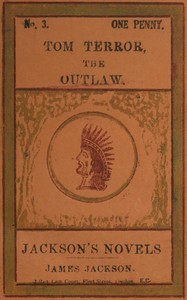
The catalog record for Tom Terror, the Outlaw — Inside the Classic provides practical reading context through 19,720 words, 1 hr 26 min estimated reading time, and 2 detected text sections.
The text analysis averages about 14.8 words per sentence, while the detected sections provide another way to judge how the source is divided.
Project Gutenberg metadata also associates the work with “Indians of North America -- Fiction,” connecting these edition facts with the source record’s subject description.
Explore this collection
These alternatives are selected using recorded categories and estimated reading time.
About 125 minutes
Exploration Survival Adventure Tales
28,615 recorded words. 39 minutes difference from this book's estimate.
View Gutenberg source #49109About 137 minutes
Exploration Survival Adventure Tales
31,383 recorded words. 51 minutes difference from this book's estimate.
View Gutenberg source #49286About 142 minutes
Exploration Survival Adventure Tales
32,454 recorded words. 56 minutes difference from this book's estimate.
View Gutenberg source #54358Search stored excerpts and compare books → Choose by your preferences →
Choices use stored catalog measurements. Estimates vary with reading speed. A shared category is a catalog label, not a claim that two books have the same argument or literary quality.
Search reads excerpt text stored with this catalog and links to its associated Gutenberg record. The connection is stored in the site database; this tool does not recheck that every excerpt is word-for-word identical to that external record. Excerpt search does not cover every chapter and does not verify historical publication dates.
Catalog snapshot checked: 2026-09-25. Coverage: 94 public books, 94 available source excerpts.
Read the complete public-domain text at its original source.
Read on Project GutenbergTom Terror opens with a hanging gone wrong: the outlaw, rope already around his neck, spurs his horse and bolts from a score of Vigilantes. The narrator calls this a mistake—letting him ride his own mount—and the scene establishes a pattern of narrow escapes and quick reversals. Within a few paragraphs, the reader meets the Gulch Tiger alone in a canyon, watching six Indians approach. The prose is lean, the dialogue salted with dialect (“I war right”), and the action moves at a gallop. This is a penny-dreadful western, serialized in cheap numbers, and the opening wastes no time introducing its central figure: a man who has already earned a name “that will never be erased from the annals of danger and death.”
The first chapter hinges on a single tactical error: the Vigilantes of Custer allowed Tom Terror to ride his own horse to the execution site. A word, a snort, a leap—and he is free. The narrator underlines the lesson: “the bird in the hand on that occasion did not prove worth two in the bush.” This opening sets the stakes for the entire story. Tom is not merely a fugitive; he is a man who has returned to the canyon where he nearly died, and he finds his old gang reduced to six. The reader is left to wonder what happened during his five-month absence and whether the Vigilantes will get a second chance. The scene also introduces the Indians, who carry “a weapon of death more horrible than the singing bullet”—a detail that hints at the violence to come.
Midway through the excerpts, the focus shifts to a new pair of characters: a boy named Hal and a girl, Myra, who wears masculine attire. The narrator notes that “the quick eye of the Gulch Tiger detected the dissimilarity of their features, and decided that one belonged to the gentler sex.” Myra’s auburn hair and figure give her away. Hal, meanwhile, is a “boy lyncher”—a young judge who has already strung up men. When Tom Terror catches them at the edge of Cut-throat cliff, the confrontation becomes a test of nerve. Hal disarms Tom by counting down, forcing him to throw his rifle and pistols over the precipice. But Tom is not cowed; he jokes about the “air-dance” and taunts the boy for lacking a rope. The power dynamic shifts constantly, keeping the reader uncertain who holds the upper hand.
The later excerpt deepens the suspense. Hal orders Tom to climb down the cliff to retrieve a rope from a gallows beam, claiming he has used it twice before. Tom peers over the edge and seems to confirm the rope’s presence, but his expression suggests suspicion. The dialogue crackles with double meanings: “Can you cut him loose and bring up the rope?” Hal asks. “Cut who loose, an’ git what rope?” Tom replies. The scene is a psychological duel, with each character trying to outmaneuver the other. The setting—a narrow canyon wall, a precipice, a hidden gallows—amplifies the tension. The reader, like the characters, must guess whether the rope is real or a bluff. This moment epitomizes the story’s reliance on brinkmanship and physical peril.
Jackson’s prose is marked by colloquial exclamations (“By the jumpin’ jingo!” “Gosh all varmints!”) and a narrator who occasionally addresses the reader directly. The story was published as a cheap weekly, and its style reflects that: fast-paced, episodic, and heavy on dialogue. The excerpts show a fondness for dramatic irony—the reader knows Tom’s identity before the Indians do, and later watches Hal and Myra walk into danger. The vocabulary is simple but vivid: “a brace of youthful figures,” “the singing bullet,” “the Canyon King.” These phrases give the tale a mythic quality, even as the plot remains grounded in physical action. First-time readers should pay attention to how Jackson uses dialect to distinguish characters and how the short chapters build toward cliffhangers.
These excerpts offer only a partial view of Tom Terror, the Outlaw—roughly two of its many chapters. The full story likely follows Hal and Myra’s entanglement with Tom and the Vigilantes, with more escapes, captures, and reversals. Readers should note the story’s origins as a penny dreadful: it was designed to be consumed quickly, with each installment ending on a hook. Approach it as a fast-paced adventure rather than a nuanced character study, and watch for the recurring motifs of ropes, cliffs, and narrow escapes that define the Gulch Tiger’s world.
After finishing Tom Terror, the Outlaw, I kept thinking about that quiet moment before the final standoff—how the stillness says more than the gunfire. It lingered the same way a certain other story did, one where the weight sits just beneath the action. The Sword of Gideon — A Closer Reading has that same hush, somehow. We can talk about it whenever you feel like it.
Build a private reading journal entry for this title.