About 137 minutes
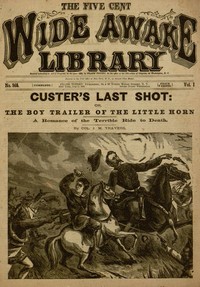
Custer's Last Shot; or, The Boy Trailer of the Little Horn — Context and Discussion
Exploration Survival Adventure Tales
31,383 recorded words. 12 minutes difference from this book's estimate.
View Gutenberg source #49286
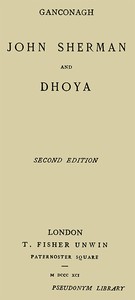
The source record for John Sherman; and, Dhoya — A Reader’s Guide measures this digital text at 28,615 words, 2 hr 5 min estimated reading time, and 33 detected text sections.
The text analysis averages about 16.1 words per sentence, while the detected sections provide another way to judge how the source is divided.
Project Gutenberg metadata also associates the work with “Tales -- Ireland -- Adaptations,” connecting these edition facts with the source record’s subject description.
Explore this collection
These alternatives are selected using recorded categories and estimated reading time.
About 137 minutes
Exploration Survival Adventure Tales
31,383 recorded words. 12 minutes difference from this book's estimate.
View Gutenberg source #49286About 142 minutes
Exploration Survival Adventure Tales
32,454 recorded words. 17 minutes difference from this book's estimate.
View Gutenberg source #54358About 86 minutes
Exploration Survival Adventure Tales
19,720 recorded words. 39 minutes difference from this book's estimate.
View Gutenberg source #55258Search stored excerpts and compare books → Choose by your preferences →
Choices use stored catalog measurements. Estimates vary with reading speed. A shared category is a catalog label, not a claim that two books have the same argument or literary quality.
Search reads excerpt text stored with this catalog and links to its associated Gutenberg record. The connection is stored in the site database; this tool does not recheck that every excerpt is word-for-word identical to that external record. Excerpt search does not cover every chapter and does not verify historical publication dates.
Catalog snapshot checked: 2026-09-25. Coverage: 94 public books, 94 available source excerpts.
Read the complete public-domain text at its original source.
Read on Project GutenbergThe volume opens not with a story but with an apology from a speaker who calls himself an "old little Irish spirit" sitting in hedges, watching boys drive donkeys and girls carry apple baskets. This framing device, attributed to a historian named O'Kearney, immediately establishes a tone of whimsical detachment: the spirit claims to care for "nothing in the world but love and idleness." He dismisses the first tale as dealing with "dull persons and the world's affairs," reserving his affection for the second, which concerns "my own people." Readers encountering this preface should note that the author, W. B. Yeats, published under the pseudonym Ganconagh—the name of a Irish fairy seducer—blurring the line between author and narrator. The apology thus serves as a key to the book's dual nature: a realistic novel followed by a mythological story, both filtered through a fairy's perspective.
The first chapter of John Sherman introduces its protagonist in the west of Ireland, though the excerpt is truncated. What survives from later chapters reveals a young man who works as a clerk in London and returns to his provincial hometown, Ballah. His mother, Mrs. Sherman, is puzzled by his sudden invitation to a friend, the Rev. William Howard—a decision they usually discuss for weeks. This small domestic friction hints at Sherman's impulsive nature and his mother's quiet resistance. The narrative voice is precise about social dynamics: Mrs. Sherman "would not object to any visitor of her son's, but quite made up her mind in no manner to put herself out to entertain" the clergyman. Such details ground the story in the mundane rhythms of Irish provincial life, a world the fairy narrator claims to find tedious.
In London, Sherman's spirits improve markedly after his return from Ballah. His fellow-clerks notice "a lark-like cheerfulness and alacrity breaking out at odd moments." He visits Miss Margaret Leland, who scolds him for a formal note but is glad to see him return "to his allegiance." Their conversation reveals a playful tension: she calls herself an agnostic, he is orthodox; she has trained him to chatter, calling him a "barbarian." When Sherman mentions his friend the Rev. William Howard, describing him as "very mediæval," Margaret retorts that she likes "everything mediæval" but not curates. The dialogue is crisp and character-revealing, with Sherman's abrupt question to a fellow-clerk—"Are you an agnostic?"—underscoring his social awkwardness. This section establishes the romantic and ideological conflicts that will drive the novel's middle portion.
The third excerpt introduces the Rev. William Howard through a lengthy, almost satirical character sketch. He has lost many parishes due to his habit of adopting "strange opinions" and preaching them startlingly. His sermon on unbaptized children is cited as an instance where the idea "possessed him for a day." He delights in High Church practices—candles on altars, crosses in unexpected places, confession, prayers for the dead—which fill his parishioners with one dread: popery. The narrator lists the entire community, from rector to children making mud pies, as united in opposition. Howard's consolation comes from a "little circle of the faithful," younger ladies who imagine him in ancient attitudes before tapestry. The prose is energetic and slightly mocking, describing him as "an efficient crusader" whose efficiency gives his thoughts "a certain over-completeness and isolation." This portrait, drawn from the novel's middle section, suggests that Howard will serve as a foil to Sherman's more passive nature.
The second tale, Dhoya, begins after the novel's conclusion. Its title character is a giant, and the story belongs to the fairy narrator's "own people." The excerpts provided do not include the opening of Dhoya, but the table of contents shows it is divided into three chapters. Given Yeats's later immersion in Celtic mythology, readers can expect a narrative steeped in the supernatural, contrasting sharply with the social realism of John Sherman. The fairy's apology explicitly prefers this tale, promising a shift from "the world's affairs" to a realm of love and idleness. The juxtaposition of the two works invites comparison: the mundane struggles of Sherman against the mythic passions of Dhoya, both filtered through the voice of a hedge-spirit who claims to have seen all from his hole in the hedge.
Reading the two works in sequence, as the volume presents them, allows the fairy's apology to color both. The mundane details of Sherman's life—clerkships, courtship, clerical controversy—gain a faintly ironic light when introduced by a spirit who finds them dull. Meanwhile, Dhoya may feel like the reward promised by the preface. Readers should attend to the recurring motif of watching from the hedge: the fairy narrator claims to have seen everything from that vantage, and his voice, at times "distant and dreamy," may be the book's most consistent presence.
There’s a particular wistfulness in this Yeats pairing—the pull between quiet roots and restless longing, that odd ache of being neither here nor fully elsewhere. It reminded me of another story I once kept close, one where judgment feels less like a verdict and more like a weather. The Virgin in Judgment — Story, Setting & Ideas carries that same strange grey light, a hush between choices, as if the earth itself were holding its breath.
Use these questions to collect your thoughts before moving on.