About 348 minutes
A Vendetta of the Hills — Reading Notes
Exploration Survival Adventure Tales
79,886 recorded words. 44 minutes difference from this book's estimate.
View Gutenberg source #52289
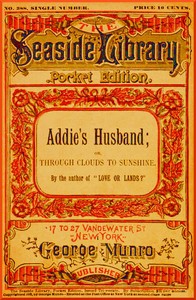
The catalog record for Addie's Husband; or, Through clouds to sunshine — Edition Insights provides practical reading context through 90,045 words, 6 hr 32 min estimated reading time, and 9 detected text sections.
The text analysis averages about 16.1 words per sentence, while the detected sections provide another way to judge how the source is divided.
Project Gutenberg metadata also associates the work with “England -- Social life and customs -- 19th century -- Fiction,” connecting these edition facts with the source record’s subject description.
Explore this collection
These alternatives are selected using recorded categories and estimated reading time.
About 348 minutes
Exploration Survival Adventure Tales
79,886 recorded words. 44 minutes difference from this book's estimate.
View Gutenberg source #52289About 464 minutes
Exploration Survival Adventure Tales
106,676 recorded words. 72 minutes difference from this book's estimate.
View Gutenberg source #52979About 310 minutes
Exploration Survival Adventure Tales
71,203 recorded words. 82 minutes difference from this book's estimate.
View Gutenberg source #53133Search stored excerpts and compare books → Choose by your preferences →
Choices use stored catalog measurements. Estimates vary with reading speed. A shared category is a catalog label, not a claim that two books have the same argument or literary quality.
Search reads excerpt text stored with this catalog and links to its associated Gutenberg record. The connection is stored in the site database; this tool does not recheck that every excerpt is word-for-word identical to that external record. Excerpt search does not cover every chapter and does not verify historical publication dates.
Catalog snapshot checked: 2026-09-25. Coverage: 94 public books, 94 available source excerpts.
Read the complete public-domain text at its original source.
Read on Project GutenbergThe excerpt opens with a striking contrast: Addie waits in a frosty night, knowing her husband's thoroughbreds have been pawing the gravel for half an hour, while he, weary, longs for rest. Yet her sister detains them, claiming Mr. Armstrong is tired. This small domestic friction—a wife's patience versus a sister's selfishness—sets the stage for a novel that examines marriage through the lens of social performance.
The ballroom scene that follows introduces Pauline Lefroy and Flo Wynyard, who strike up a defensive alliance against male gossip. Flo's frankness—"my bark is worse than my bite"—and her rivalry with Pauline as "rival queens" suggest that the novel's tensions are not only marital but also between women navigating a judgmental society.
The opening lines of the excerpt establish a quiet but telling imbalance. Addie is described as "sleepy and impatient," while her husband is "somewhat weary, longing for a few hours' rest." The detail of the "thoroughbreds pawing the gravel in the frosty night" adds a sensory layer—wealth and status do not erase physical exhaustion. The sister's claim that Mr. Armstrong is "very tired" and must rise early for business introduces a note of social obligation: even fatigue is managed according to propriety. This small scene hints at a marriage where the wife's desires are secondary to social demands, a pattern that may recur throughout the novel.
In the conservatory, Flo Wynyard confronts her cousin Everard for neglecting her at a dance, then turns to Pauline with a proposal: "Suppose you and I strike up a defensive alliance in the cause of common womanhood." Her self-description—"fast and speak out plainly"—and her admission that half the men and all the old women expect her to hate Pauline for being younger and handsomer, reveal a society where women are pitted against each other. The historical references to Mary, Queen of Scots and Elizabeth, and to Mrs. Clive and Mrs. Oldfield, frame their rivalry as theatrical and inevitable. Yet the alliance they form suggests a countercurrent of solidarity, one that may test the novel's marital plot.
The dialogue in the excerpt is brisk and laced with irony. Flo's boldness—"Isn't a cousin a detestable institution?"—and Everard's teasing retorts create a tone of social sparring. Pauline's quick acceptance of the alliance—"I'm quite ready to enter an alliance with you on the spot"—shows her as adaptable and perceptive. The narrator's voice, meanwhile, is detached and observant, noting how Pauline "crimsons to the roots of her hair" at a perceived insult, then relaxes. This attention to physical and emotional cues suggests a novel that tracks the gap between public performance and private feeling, a theme central to the marital drama implied by the title.
Readers attentive to the novel's subtitle, "Through Clouds to Sunshine," will watch for how the opening tensions—between waiting and acting, rivalry and alliance, weariness and obligation—resolve. The excerpt offers no clear villain or hero, only characters caught in a web of social expectations. The marriage of Addie and her husband, glimpsed only through her impatience and his fatigue, may be the central cloud; whether the sunshine comes through mutual understanding or external events remains to be seen.
There’s something tender in watching Addie wait while her husband tires of the world’s noise—that quiet ache of wanting someone to meet you where you are. I found myself thinking of another lonely vigil, the old hall’s shadows in The Story of Beowulf, Translated from Anglo-Saxon into Modern English Prose — Key Ideas to Explore, where courage is just another form of patience. We all wait, don’t we, for sunlight through clouds.
Capture what you thought, learned, and would like to remember.