About 142 minutes
Gettysburg: Stories of the Red Harvest and the Aftermath — Story, Setting & Ideas
Exploration Survival Adventure Tales
32,454 recorded words. 5 minutes difference from this book's estimate.
View Gutenberg source #54358
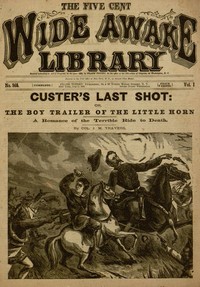
Custer's Last Shot; or, The Boy Trailer of the Little Horn — Context and Discussion can be approached with a clearer sense of reading commitment from its source measurements: 31,383 words, 2 hr 17 min estimated reading time, and 4 detected text sections.
The text analysis averages about 20.9 words per sentence, while the detected sections provide another way to judge how the source is divided.
Project Gutenberg metadata also associates the work with “Dime novels,” connecting these edition facts with the source record’s subject description.
Explore this collection
These alternatives are selected using recorded categories and estimated reading time.
About 142 minutes
Exploration Survival Adventure Tales
32,454 recorded words. 5 minutes difference from this book's estimate.
View Gutenberg source #54358About 125 minutes
Exploration Survival Adventure Tales
28,615 recorded words. 12 minutes difference from this book's estimate.
View Gutenberg source #49109About 170 minutes
Exploration Survival Adventure Tales
39,062 recorded words. 33 minutes difference from this book's estimate.
View Gutenberg source #50742Search stored excerpts and compare books → Choose by your preferences →
Choices use stored catalog measurements. Estimates vary with reading speed. A shared category is a catalog label, not a claim that two books have the same argument or literary quality.
Search reads excerpt text stored with this catalog and links to its associated Gutenberg record. The connection is stored in the site database; this tool does not recheck that every excerpt is word-for-word identical to that external record. Excerpt search does not cover every chapter and does not verify historical publication dates.
Catalog snapshot checked: 2026-09-25. Coverage: 94 public books, 94 available source excerpts.
Read the complete public-domain text at its original source.
Read on Project GutenbergDespite its title and catalog classification as a Custer fiction, Custer's Last Shot; or, The Boy Trailer of the Little Horn devotes surprisingly little of its surviving excerpts to the general or the battle itself. The opening chapter introduces a buckskin-clad hunter confronting a boastful Indian chief named Yellow Hawk, establishing a tone of vernacular dialogue and frontier bravado. The historical event serves more as a backdrop than a driver of the plot.
The excerpts are heavy with stylized dialect, particularly in the speech of the hunter and the outlaw Hoskins. The hunter's opening line—"Hold up yer hands thar, ye varmints"—sets a pattern of phonetic spelling and rustic phrasing. Hoskins later declares, "I've bought ye with a price, and I'd jest like fur the man to show himself what's goin' to take ye from me." This consistent use of nonstandard English distinguishes the rough frontier characters from the more standard narration. The Indian chief Yellow Hawk speaks in a clipped, stereotypical pattern: "Ugh! me big chief. Hunter must hear of Yellow Hawk." These choices reflect the dime novel's reliance on recognizable types rather than nuanced characterization.
The central conflict in the excerpts is not Custer's last stand but the captivity of a girl named Adele. She is held by the Creole Pedro Sanchez, who attempts to sell her to Hoskins for "two hundred shiners" and a horse. The hero, Mason, observes from hiding, gritting his teeth as he recognizes Sanchez as the man who shot him. The rescue is executed by Red Goliath, who bursts through a lodge with a knife and revolver, declaring "I'm the identical chap." This sequence—complete with a sighing captive, a villainous bargain, and a dramatic entrance—is pure melodrama, far removed from the historical battle promised by the title.
The Project Gutenberg catalog lists this work under "Little Bighorn, Battle of the, Mont., 1876 -- Fiction" and "Custer, George A. ... -- Fiction." Yet the excerpts contain no direct depiction of Custer or the battle. The title appears only in the book's front matter and chapter headings. The narrative instead follows a boy trailer, a captive girl, and a cast of outlaws. The battle is referenced obliquely—a tin cup "that had lately belonged to one of Custer's men" appears as a prop. This mismatch suggests the catalog subjects may reflect the publisher's marketing rather than the story's actual focus. Readers expecting a military historical fiction will find instead a frontier adventure with only tangential ties to the Little Bighorn.
Readers approaching this dime novel should set aside expectations of a Custer-centric narrative. The excerpts offer a fast-paced rescue story with broad character types and heavy dialect. The historical battle functions as a distant backdrop, not a central event. For those interested in the conventions of 1880s popular fiction—melodrama, vernacular speech, and formulaic plotting—this work provides a clear example, but it is not a reliable source for the events of June 1876.
There’s something oddly sweet about a book that promises Custer but delivers a boy and a villain's girl instead. I kept thinking how the real story hides behind the loud one. That same quiet surprise waits in My "Pardner" and I (Gray Rocks): A Story of the Middle-West — Reading Companion, where the landscape matters more than the plot’s noise. Just a slower kind of truth. I miss that.
A brief reflection can help important ideas stay with you longer.