About 267 minutes
Miss Esperance and Mr Wycherly — A Reader’s Guide
Exploration Survival Adventure Tales
61,217 recorded words. 6 minutes difference from this book's estimate.
View Gutenberg source #54538
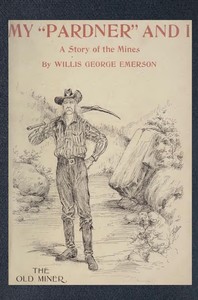
This digital edition of My "Pardner" and I (Gray Rocks): A Story of the Middle-West — Reading Companion is described by source-level measurements including 62,688 words, 4 hr 33 min estimated reading time, and 11 detected text sections.
The text analysis averages about 18.6 words per sentence, while the detected sections provide another way to judge how the source is divided.
Project Gutenberg metadata also associates the work with “Miners -- Fiction,” connecting these edition facts with the source record’s subject description.
Explore this collection
These alternatives are selected using recorded categories and estimated reading time.
About 267 minutes
Exploration Survival Adventure Tales
61,217 recorded words. 6 minutes difference from this book's estimate.
View Gutenberg source #54538About 310 minutes
Exploration Survival Adventure Tales
71,203 recorded words. 37 minutes difference from this book's estimate.
View Gutenberg source #53133About 348 minutes
Exploration Survival Adventure Tales
79,886 recorded words. 75 minutes difference from this book's estimate.
View Gutenberg source #52289Search stored excerpts and compare books → Choose by your preferences →
Choices use stored catalog measurements. Estimates vary with reading speed. A shared category is a catalog label, not a claim that two books have the same argument or literary quality.
Search reads excerpt text stored with this catalog and links to its associated Gutenberg record. The connection is stored in the site database; this tool does not recheck that every excerpt is word-for-word identical to that external record. Excerpt search does not cover every chapter and does not verify historical publication dates.
Catalog snapshot checked: 2026-09-25. Coverage: 94 public books, 94 available source excerpts.
Read the complete public-domain text at its original source.
Read on Project GutenbergWillis George Emerson's My "Pardner" and I (Gray Rocks) opens with a preface that frames the novel as a contribution to the unwritten history of mining prospectors and boom-town builders in the American West. The narrative quickly establishes a pattern of movement between Vance Gilder's former life in New York and his new surroundings in Gold Bluff, Idaho. Emerson uses the physical journey—stage rides, walks through town, descents into mines—to mirror Gilder's internal shifts in loyalty and desire. The recurring image of Gray Rocks, a landmark mentioned in the subtitle and the prefatory poem, serves as a fixed point around which the characters' ambitions and affections revolve.
The stagecoach appears repeatedly as a mechanism for entering and leaving Gold Bluff, marking key transitions in the plot. Chapter IX is titled "The Stage Driver," and Chapter XIII is simply "The Stage Ride." These journeys are not mere travel; they are moments of reflection and decision. When Vance Gilder first arrives, the stage brings him from the East into a landscape of "picturesque scenery" that contrasts with the "hot and crowded metropolis." Later, the stage is robbed in Chapter XX, an event that disrupts the town's routine and forces characters to react. Emerson uses the stage's arrival and departure to punctuate the narrative, creating a rhythm of anticipation and consequence. The physical movement between Waterville and Gold Bluff also underscores the tension between established towns and speculative mining camps, a central concern of the novel.
The phrase "Gray Rocks" appears in the subtitle and the opening poem, which describes "yonder rocky peak" and "crimson crags." Throughout the excerpts, the landscape is repeatedly described in terms of its geological features: mountains, canyons, and the mine itself. In Chapter XVII, Vance reflects on his love for "the picturesque scenery of the mountains, rivers, valleys." The rocks are not just backdrop; they are tied to the mine's value and to Louise's home. The novel's title suggests a partnership—"My 'Pardner' and I"—but the parenthetical "Gray Rocks" anchors that partnership in a specific, rugged place. Emerson returns to this imagery at emotional peaks, such as when Vance hears Louise sing and feels his soul "break through the barriers." The solidity of the rocks contrasts with the fluidity of his feelings.
Emerson alternates between indoor scenes—supper parties, town meetings, editorial offices—and outdoor settings like the mine, the stage road, and the trout stream. This movement creates a dynamic sense of place. In Chapter IV, "A Supper Party" introduces social dynamics within a domestic interior, while Chapter VIII, "At the Mine," shifts to the industrial and natural landscape. The contrast is sharp: the mine is a place of labor and potential wealth, while the parlor is where Vance and Louise exchange confidences. The novel's structure depends on these shifts; each new location brings new information or conflict. For instance, the indignation meeting in Chapter XIX takes place in a public hall, a space where community tensions erupt. By moving characters between these spheres, Emerson shows how personal and economic lives intertwine.
In Chapter XVII, Louise sings for Vance, and the event marks a clear before-and-after in his emotional state. Emerson describes the song in detail: she begins "hesitatingly" but soon sings "with wild abandon." The lyrics, quoted in full, speak of a heart that "would flutter like a frightened bird." Vance responds with "intoxication" and realizes "a great and tender love had sprung up." This scene is structurally pivotal—it follows Vance's loss of his job on the Banner and his decision to stay in Gold Bluff. The song does not advance the mining plot, but it reorients the protagonist's priorities. Emerson uses music as a catalyst for introspection, a technique that distinguishes this novel from purely action-driven adventure tales. The moment is carefully prepared by earlier references to Louise's musical talent and her devotion to her father.
Readers attentive to Emerson's use of physical and emotional geography will find that the novel's strength lies in its accumulation of specific, concrete details—the feel of a stagecoach ride, the sound of a contralto voice, the sight of gray rocks against a mountain sky. The narrative rewards those who track how characters move through these spaces and how those movements alter their relationships. The incomplete excerpts leave questions about the fate of the Peacock Mine and the resolution of Vance's romantic and professional ambitions, but the patterns established in the first half of the book offer a reliable guide to the story's concerns.
Rereading the note on Emerson’s Gray Rocks, I found myself dwelling on that quiet moment when song breaks the solitude—how a tune can bridge two very different landscapes. It reminded me of another, gentler book, Miss Esperance and Mr Wycherly — A Reader’s Guide, where a similar thread of music seems to stitch two lonely hearts together, unhurriedly.
Build a private reading journal entry for this title.