About 273 minutes
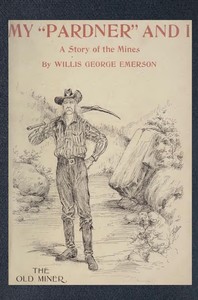
My "Pardner" and I (Gray Rocks): A Story of the Middle-West — Reading Companion
Exploration Survival Adventure Tales
62,688 recorded words. 6 minutes difference from this book's estimate.
View Gutenberg source #52458
This digital edition of Miss Esperance and Mr Wycherly — A Reader’s Guide is described by source-level measurements including 61,217 words, 4 hr 27 min estimated reading time, and 9 detected text sections.
The text analysis averages about 18.4 words per sentence, while the detected sections provide another way to judge how the source is divided.
Project Gutenberg metadata also associates the work with “Orphans -- Fiction,” connecting these edition facts with the source record’s subject description.
Explore this collection
These alternatives are selected using recorded categories and estimated reading time.
About 273 minutes
Exploration Survival Adventure Tales
62,688 recorded words. 6 minutes difference from this book's estimate.
View Gutenberg source #52458About 310 minutes
Exploration Survival Adventure Tales
71,203 recorded words. 43 minutes difference from this book's estimate.
View Gutenberg source #53133About 348 minutes
Exploration Survival Adventure Tales
79,886 recorded words. 81 minutes difference from this book's estimate.
View Gutenberg source #52289Search stored excerpts and compare books → Choose by your preferences →
Choices use stored catalog measurements. Estimates vary with reading speed. A shared category is a catalog label, not a claim that two books have the same argument or literary quality.
Search reads excerpt text stored with this catalog and links to its associated Gutenberg record. The connection is stored in the site database; this tool does not recheck that every excerpt is word-for-word identical to that external record. Excerpt search does not cover every chapter and does not verify historical publication dates.
Catalog snapshot checked: 2026-09-25. Coverage: 94 public books, 94 available source excerpts.
Read the complete public-domain text at its original source.
Read on Project GutenbergL. Allen Harker’s Miss Esperance and Mr Wycherly opens with a description of a house called Remote, a small stone dwelling that “had stood four-square to all the winds of heaven” long before the village of Burnhead crept up around it. This architectural isolation mirrors the social position of Miss Esperance herself, a little old lady who “walked delicately and talked deliberately the English of Mr. Addison.” The narrative movement between the house, the garden, and the village street forms a recurring structural pattern, one that Harker uses to frame encounters between the elderly scholar Mr. Wycherly and the orphaned children who disrupt his settled life.
The narrative repeatedly returns to the house Remote as a fixed point. Harker describes it as “a small, square house set in a big, homely garden,” and the green gate that “creaked” becomes a signal of arrivals and departures. The house is not merely a setting but a structural device: scenes begin or end with characters entering or leaving its garden, and the interior—particularly the Sunday dinner table—serves as a stage for moral negotiations. When Edmund hides from church, the action moves from the garden to the sofa in Mr. Wycherly’s room, and the tension resolves only when the child is led back toward the house and his aunt. This choreography of thresholds gives the novel a clear, almost theatrical rhythm.
Harker anchors key moments in physical sensations. The smell of sage and onions “grew stronger and stronger” through the little house, penetrating even to Mause in the garden, and this olfactory cue coincides with Edmund’s awakening and his theological bargaining with Mr. Wycherly. Later, Mr. Wycherly “grew stiff with kneeling” after praying beside the sofa—a small bodily detail that underscores his age and his earnestness. These sensory anchors are not decorative; they mark shifts in the narrative’s emotional temperature. The creak of the green gate, the smell of Sunday dinner, the physical discomfort of kneeling: each reappears at structurally significant moments, grounding abstract moral questions in tangible experience.
The excerpted chapters show a pattern of movement between the domestic sphere and the village church. Miss Esperance expects Edmund and Montagu to attend church, but Edmund hides, leading to a prolonged scene in Mr. Wycherly’s room. The dialogue about church attendance becomes a vehicle for character revelation: Edmund’s pragmatic logic (“Why can’t I be brought up in your church? Then we needn’t neither of us never go”) contrasts with Mr. Wycherly’s earnest recollection of his own daily attendance at Oxford. The scene ends with Edmund’s reluctant agreement to apologize, but the narrative does not follow him to church; instead, it remains in the house, suggesting that the domestic negotiation is the true locus of moral development.
Burnhead is described as having “crept up” around Remote, and this encroachment is echoed in the way village characters—Mause, the gardener, the unnamed “commonplace people”—enter the story. The village is not a backdrop but a force that shapes the plot. Miss Esperance’s position as a benefactor to “innumerable people poorer than herself” ties her to the community, while Mr. Wycherly’s scholarly detachment is tested by the village’s demands. The narrative moves between the privacy of Remote and the public space of the village street, and these transitions often coincide with shifts in power or perspective. The village, like the house, is a structural element that Harker uses to modulate pace and focus.
Readers attentive to Harker’s use of space and sensation will find a novel that builds its moral drama not through grand events but through the repeated, deliberate movement of characters between garden, house, and village. The creaking gate, the smell of cooking, the stiffness of an old man’s knees—these are the threads that stitch the narrative together. Approach the text as a series of carefully staged scenes, each anchored in a specific place and a specific physical detail, and the story’s quiet architecture becomes visible.
Rereading the guide's notes on Burnhead and its creaking gates, I found myself thinking of another book’s quiet corners. There is the same tenderness in watching older characters navigate their routines—the sage, the stiff knees—as there is in Eden Phillpotts' handling of solitary lives. It is a gentle echo, that particular loneliness one finds in a village. The Virgin in Judgment — Story, Setting & Ideas carries that same weather-worn patience, I recall.
Your answers remain private and are stored only in this browser.