About 225 minutes
A Study In Shadows — Reading Companion
Fairy Tales Myths Imaginary Worlds
51,555 recorded words. 41 minutes difference from this book's estimate.
View Gutenberg source #53995
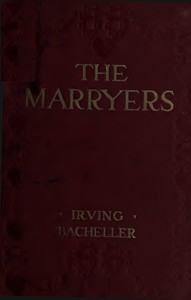
The source record for The Marryers: A History Gathered from a Brief of the Honorable Socrates Potter — Inside the Classic measures this digital text at 42,259 words, 3 hr 4 min estimated reading time, and 5 detected text sections.
The text analysis averages about 14.5 words per sentence, while the detected sections provide another way to judge how the source is divided.
Project Gutenberg metadata also associates the work with “Mate selection -- Fiction,” connecting these edition facts with the source record’s subject description.
Explore this collection
These alternatives are selected using recorded categories and estimated reading time.
About 225 minutes
Fairy Tales Myths Imaginary Worlds
51,555 recorded words. 41 minutes difference from this book's estimate.
View Gutenberg source #53995About 241 minutes
Fairy Tales Myths Imaginary Worlds
55,292 recorded words. 57 minutes difference from this book's estimate.
View Gutenberg source #47342About 242 minutes
Fairy Tales Myths Imaginary Worlds
55,462 recorded words. 58 minutes difference from this book's estimate.
View Gutenberg source #48453Search stored excerpts and compare books → Choose by your preferences →
Choices use stored catalog measurements. Estimates vary with reading speed. A shared category is a catalog label, not a claim that two books have the same argument or literary quality.
Search reads excerpt text stored with this catalog and links to its associated Gutenberg record. The connection is stored in the site database; this tool does not recheck that every excerpt is word-for-word identical to that external record. Excerpt search does not cover every chapter and does not verify historical publication dates.
Catalog snapshot checked: 2026-09-25. Coverage: 94 public books, 94 available source excerpts.
Read the complete public-domain text at its original source.
Read on Project GutenbergThe Marryers opens with a framing device that is itself a wry legal document: a brief addressed to the 'Honorable Judges of Decency and Good Behavior the World Over' by the Honorable Socrates Potter. This narrator, a lawyer from Pointview, Connecticut, immediately establishes a tone of measured irony, warning that he has included 'enough wine' for illusion and 'enough truth' for conscience. The story that follows is presented as a history gathered from his brief, not a novel, and the author leans into this conceit throughout. Potter's voice—colloquial, self-deprecating, and fond of aphorism—shapes every scene. He describes Italy as 'the land of love and song' and recommends it for those pursuing careers in either, a dry joke that sets up the central tension between American sincerity and European artifice.
Socrates Potter is not a passive observer but an active commentator whose legal training colors his descriptions. He speaks of 'putting the case in good hands' and evaluates romantic strategies as if they were courtroom tactics. When the young American lover Norris declares he will not use 'guitar music' to win a woman, Potter agrees: 'it's so awful easy to make words lie.' This distrust of rhetoric extends to the narrator's own prose. He admits he has 'tried to tell the truth, but with that moderation which becomes a lawyer of my age and experience.' The result is a narrative that constantly questions its own reliability while appearing frank. Potter's asides—such as noting that 'a good attorney never tells all he knows unless he is writing a book'—remind the reader that this is a crafted testimony, not a transparent confession.
The dialogue attributed to Norris, the multimillionaire, reveals a deliberate rejection of romantic cliché. He speaks of love as a 'sacred thing' but also as a 'business' that 'looks for dividends of happiness.' His language is plain, almost contractual: 'I want to stay married'; 'she must have time to be sure of one thing—that I am the right man.' He refuses to 'enter a lying-match with these Romeos' unless it is understood as a game. This vocabulary—'lying-match,' 'game,' 'business'—positions Norris as a foil to the European suitors who rely on 'passionate vows or bouquets or guitar music.' The narrator's approval is explicit: 'Here was the modern American lover, and I must acknowledge that I fell in love with him.' The author uses Norris's diction to embody a new chivalry based on honesty rather than performance.
Physical disguise signals character change. The figure of Muggs appears first with a mustache, then later 'his mustache had disappeared, as had my hat and coat and the old suit of clothes,' and he now wears a 'blue monocle.' The narrator notes how this 'changed the whole effect of Muggs.' The transformation is not merely cosmetic; Muggs announces he is 'beginning a new life from the ground up.' The author uses such alterations to question identity and sincerity. Norris, too, is described as a man who has been 'holding down the bushel that hides his light,' suggesting a deliberate concealment of his true self. The motif of hiding and revealing—of light under a bushel, of a monocle removed to smile—runs through the excerpts, reinforcing the theme that appearances in Italy are unreliable and that genuine character must be uncovered.
Italy is not merely a backdrop but an active force in the narrative. Potter describes it as a place where 'art, scenery, and wine have been a great help to the song business' and where 'pictures, statues, and soft air are well calculated to keep the sexes from drifting apart.' This is a comic exaggeration, but it establishes Italy as a land of romantic illusion. The Spanish Stairs are noted as a place where 'converging ways poured a thin, noisy fall of tourists and guide-books.' The Pantheon becomes a 'thicket of vast columns' where Muggs reappears. These landmarks are not described with awe but with a lawyer's eye for detail and a dry humor. The setting serves to highlight the contrast between American pragmatism and European artifice, a contrast that drives the plot and the narrator's commentary.
Readers should attend to the tension between Potter's professed plain speaking and his evident delight in storytelling. The brief format allows Bacheller to blend legal jargon with travelogue, satire with romance. The excerpts suggest a work that is more interested in attitudes toward love than in love itself, and more concerned with the performance of sincerity than with sincerity unadorned. The recurring image of light under a bushel—of hidden worth waiting to be revealed—offers a key to the novel's moral geometry.
There’s something touching about Bacheller’s lawyer learning that honest love beats all the guitar music in the world. It makes me think of those quieter evenings when a story settles in like an old friend. I sometimes revisit Round the Fire Stories — Text and Context the same way, feeling that same warm firelight glow from a hundred years ago.
A brief reflection can help important ideas stay with you longer.