About 398 minutes
The Plunderers: A Novel — Inside the Classic
Fairy Tales Myths Imaginary Worlds
91,460 recorded words. 5 minutes difference from this book's estimate.
View Gutenberg source #51970
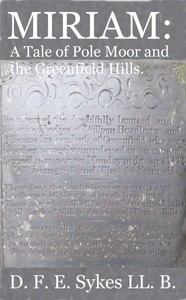
The source record for Miriam: A Tale of Pole Moor and the Greenfield Hills — Key Ideas to Explore measures this digital text at 92,530 words, 6 hr 43 min estimated reading time, and 8 detected text sections.
The text analysis averages about 20.1 words per sentence, while the detected sections provide another way to judge how the source is divided.
Project Gutenberg metadata also associates the work with “Yorkshire (England) -- Fiction,” connecting these edition facts with the source record’s subject description.
Explore this collection
These alternatives are selected using recorded categories and estimated reading time.
About 398 minutes
Fairy Tales Myths Imaginary Worlds
91,460 recorded words. 5 minutes difference from this book's estimate.
View Gutenberg source #51970About 469 minutes
Fairy Tales Myths Imaginary Worlds
107,775 recorded words. 66 minutes difference from this book's estimate.
View Gutenberg source #54109About 306 minutes
Fairy Tales Myths Imaginary Worlds
70,155 recorded words. 97 minutes difference from this book's estimate.
View Gutenberg source #54418Search stored excerpts and compare books → Choose by your preferences →
Choices use stored catalog measurements. Estimates vary with reading speed. A shared category is a catalog label, not a claim that two books have the same argument or literary quality.
Search reads excerpt text stored with this catalog and links to its associated Gutenberg record. The connection is stored in the site database; this tool does not recheck that every excerpt is word-for-word identical to that external record. Excerpt search does not cover every chapter and does not verify historical publication dates.
Catalog snapshot checked: 2026-09-25. Coverage: 94 public books, 94 available source excerpts.
Read the complete public-domain text at its original source.
Read on Project GutenbergThe novel opens with a first-person narrator recalling the Saddleworth Wakes of 1829, immediately grounding the reader in a specific time and place. The voice is unhurried, attentive to physical detail—the worm-eaten boards, the bottle-green window glass, the creaking turn-up bed shared with a companion of unusual size. This domestic realism, laced with dialect and a wry humour, establishes a narrative mode that will shift between intimate interiors and the exposed moorland landscape.
The story moves constantly between inside and outside spaces: the bedroom, the kitchen, the inn, and the open moor. The narrator’s convalescence at Pole Moor Manse is a prolonged interior scene, yet it is punctuated by arrivals and departures—Jim Haigh’s visits, the father’s soft-footed approach, Ruth’s serving of browies. These thresholds are not merely settings but structural devices. The murder at the Moorcock Inn, mentioned in the introduction, is the absent centre around which these domestic scenes revolve. The reader is kept at a distance from the violent event, learning of it through rumour and allusion, as when Jim reports that “th’ constable fro’ Marsden has bin nosin’ raand.” This indirect treatment creates a tension between the safety of the manse and the danger of the moor.
Sykes uses a small set of physical motifs to anchor the narrative. Hands appear repeatedly: the father’s hand patting the narrator’s, the narrator’s own wounded arm, the hand of the Master in the biblical story read aloud. Food is another insistent image—the “browies” of haver-bread and beef-dripping, the home-brewed ale, the contrast with later “tea by the quart” and “chemicals.” These details are not decorative; they mark the passage of time and the narrator’s recovery. The body itself is measured: the narrator’s six feet and fourteen stone, Jim’s four extra inches, the arm that swells and then subsides. This attention to physicality gives the story a tangible weight, even as the plot remains partly obscured.
The author’s note acknowledges the phonetic reproduction of local dialect, and the excerpts bear this out. Jim Haigh’s speech is dense with nonstandard forms: “aw knowed nowt,” “yo’ mun be sewer,” “he’s just hitchin’ for another innin’s.” This is not mere colour; it distinguishes characters by origin and social standing. The narrator, though a local, uses a more standard English, suggesting education or a different station. The dialect also roots the story in the West Riding of Yorkshire, a region with its own history of industrial change and rural isolation. When Jim says “th’ Irish ’ll use a knife on a pinch,” the remark ties the local to broader ethnic tensions, but the language itself—the dropped consonants, the vowel shifts—is the primary vehicle for place.
The excerpts show a pattern of comings and goings that structure the narrative. The narrator steals back to bed after looking out the window; Jim arrives with news and ale; the father ascends the stairs in stocking feet; Ruth brings food. Each movement is described with care, creating a rhythm that mimics the slow pace of rural life. Yet beneath this calm lies a network of absences: Ephraim has vanished, the constable is nosing around, the murder at the Moorcock is never directly shown. The narrator’s immobility during his recovery forces the action to come to him, reported through dialogue. This technique keeps the violent events at one remove, while the domestic scenes gain a charged quality, as if any arrival might bring bad news.
Readers should attend to the way Sykes uses the narrator’s limited perspective—confined to bed, dependent on visitors—to filter the story. The gaps in knowledge, the rumours, and the delayed revelations are not flaws but deliberate structural choices. The novel rewards attention to small physical details and to the cadence of dialect speech, which together build a world that feels both immediate and historically distant.
I finished that Sykes novel about the moors, and something in its quiet domestic details—those small, ordinary rooms holding grief—stayed with me longer than expected. It reminded me of another story, gentler in tone but with the same lingering ache beneath the surface, like an echo in a still valley. That one’s Mr. Wycherly's Wards — Reading Notes felt similar, somehow.
Your answers remain private and are stored only in this browser.