About 242 minutes
The Abandoned Farmer — Reading Notes
Fairy Tales Myths Imaginary Worlds
55,462 recorded words. 31 minutes difference from this book's estimate.
View Gutenberg source #48453
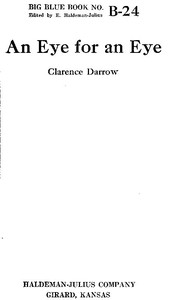
The catalog record for An eye for an eye — Edition Insights provides practical reading context through 62,753 words, 4 hr 33 min estimated reading time, and 12 detected text sections.
The text analysis averages about 24.4 words per sentence, while the detected sections provide another way to judge how the source is divided.
Project Gutenberg metadata also associates the work with “Chicago (Ill.) -- Fiction,” connecting these edition facts with the source record’s subject description.
Explore this collection
These alternatives are selected using recorded categories and estimated reading time.
About 242 minutes
Fairy Tales Myths Imaginary Worlds
55,462 recorded words. 31 minutes difference from this book's estimate.
View Gutenberg source #48453About 241 minutes
Fairy Tales Myths Imaginary Worlds
55,292 recorded words. 32 minutes difference from this book's estimate.
View Gutenberg source #47342About 306 minutes
Fairy Tales Myths Imaginary Worlds
70,155 recorded words. 33 minutes difference from this book's estimate.
View Gutenberg source #54418Search stored excerpts and compare books → Choose by your preferences →
Choices use stored catalog measurements. Estimates vary with reading speed. A shared category is a catalog label, not a claim that two books have the same argument or literary quality.
Search reads excerpt text stored with this catalog and links to its associated Gutenberg record. The connection is stored in the site database; this tool does not recheck that every excerpt is word-for-word identical to that external record. Excerpt search does not cover every chapter and does not verify historical publication dates.
Catalog snapshot checked: 2026-09-25. Coverage: 94 public books, 94 available source excerpts.
Read the complete public-domain text at its original source.
Read on Project GutenbergClarence Darrow's An Eye for an Eye opens not in a courtroom but in a Chicago switch-yard, where Hank Clery works amid moving cars and locomotives. The novel immediately establishes a world shaped by physical labor, drink, and close-knit community ties—Hank's mother, a washerwoman, routinely pays his fines. The catalyst for the plot is a visit to the county jail: Hank's old friend Jim Jackson, condemned to hang, has asked for him. The narrative voice, rooted in Hank's perspective, renders the jail and its inhabitants with a matter-of-factness that underscores the ordinariness of violence and punishment in this milieu.
The excerpts reveal a careful use of vernacular speech to distinguish characters and their social positions. Jim Jackson's confession is rendered in a colloquial, unpolished register—"I hadn't any more'n started to run till I heard a splash"—that contrasts with the more standard narration surrounding Hank's sections. This shift in voice signals the raw, unmediated quality of Jim's account, as if the reader is overhearing a private disclosure. Darrow, a famed lawyer and orator, employs dialect not for caricature but to ground the story in a specific class experience. The language of the switch-yard—"climbing up and down running cars and turning switches"—and the peddler's trade—"an old horse and wagon and began peddling potatoes"—further root the characters in their economic realities. The effect is a narrative that feels both intimate and documentary, letting the characters' own words carry the weight of their circumstances.
The longest excerpt is Jim Jackson's detailed confession of a murder, delivered to Hank in the jail. Darrow structures this as a step-by-step account, rich with sensory specifics: the moonlight on the victim's face, the feel of her heart, the splash of water. The confession is not merely a plot device but a legal and moral document, reflecting Darrow's own career as a defense attorney who often argued against capital punishment. Jim's narrative includes mundane details—feeding the horse potatoes, checking for blood on the rug—that humanize him even as he describes a horrific act. The tension between the crime's brutality and the perpetrator's ordinary concerns ("I couldn't hardly bear to go away and leave him") creates a complex portrait of a man caught between desperation and affection. Darrow avoids sensationalism; the horror emerges from the clinical precision of the telling.
The novel's Chicago setting is not mere backdrop but an active force shaping characters' fates. The switch-yard is described as a place where "climbing up and down running cars and turning switches just ahead of a great locomotive" does not "tend to a quiet life." Darrow implies a causal link between dangerous work and drinking: "most people think that no man will work in a switch-yard unless he drinks. Perhaps no man would drink unless he worked in a switch-yard." This environmental determinism extends to Jim's trajectory: after witnessing a coworker's death, he cannot return to the yards and turns to peddling, a precarious livelihood that leads to his crime. The jail itself is presented as a familiar institution—Hank has been arrested many times—and the hanging is treated as a scheduled event, not an aberration. Darrow's setting underscores how poverty and labor conditions narrow choices, making the novel an implicit argument about social justice.
Readers should attend to how Darrow balances the confession's graphic detail with the quieter moments of Hank's domestic life—his mother's washing, the sleeping child with "white curly hair just as fine as silk." These contrasts are central to the novel's meditation on punishment and humanity. The book rewards attention to its vernacular rhythms and the way setting functions as an active, often oppressive presence.
After Clarence Darrow’s story of that switchman visiting his condemned friend, I kept thinking about how circumstance carves us more than we admit. Something in that quiet ache reminded me of another old tale, one where a boy’s fate bends around secrets he never chose. Mr. Wycherly's Wards — Reading Notes stays gentle in that same lingering way, like a half-remembered window light.
Save your reaction, strongest insight, and memorable passage.