About 242 minutes
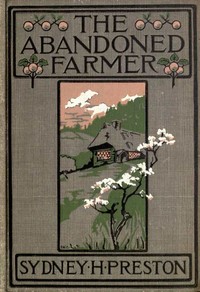
The Abandoned Farmer — Reading Notes
Fairy Tales Myths Imaginary Worlds
55,462 recorded words. 1 minutes difference from this book's estimate.
View Gutenberg source #48453
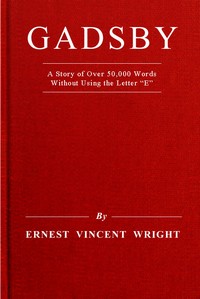
The source record for Gadsby — Reading Companion measures this digital text at 55,292 words, 4 hr 1 min estimated reading time, and 6 detected text sections.
The text analysis averages about 20.3 words per sentence, while the detected sections provide another way to judge how the source is divided.
Project Gutenberg metadata also associates the work with “Youth -- Fiction,” connecting these edition facts with the source record’s subject description.
Explore this collection
These alternatives are selected using recorded categories and estimated reading time.
About 242 minutes
Fairy Tales Myths Imaginary Worlds
55,462 recorded words. 1 minutes difference from this book's estimate.
View Gutenberg source #48453About 225 minutes
Fairy Tales Myths Imaginary Worlds
51,555 recorded words. 16 minutes difference from this book's estimate.
View Gutenberg source #53995About 273 minutes
Fairy Tales Myths Imaginary Worlds
62,753 recorded words. 32 minutes difference from this book's estimate.
View Gutenberg source #54074Search stored excerpts and compare books → Choose by your preferences →
Choices use stored catalog measurements. Estimates vary with reading speed. A shared category is a catalog label, not a claim that two books have the same argument or literary quality.
Search reads excerpt text stored with this catalog and links to its associated Gutenberg record. The connection is stored in the site database; this tool does not recheck that every excerpt is word-for-word identical to that external record. Excerpt search does not cover every chapter and does not verify historical publication dates.
Catalog snapshot checked: 2026-09-25. Coverage: 94 public books, 94 available source excerpts.
Read the complete public-domain text at its original source.
Read on Project GutenbergErnest Vincent Wright's Gadsby is a novel built around a conspicuous formal constraint: it contains not a single letter 'E'. The author explains in his introduction that he tied down the E key on his typewriter to enforce this rule, a method that directly shapes the book's diction, sentence structure, and narrative voice. The result is a text where common words like 'the', 'he', 'she', 'and', and past-tense verbs ending in '-ed' are entirely absent, replaced by synonyms and circumlocutions. This editorial note examines how Wright's self-imposed limitation influences the novel's descriptive passages, dialogue, and character interactions, drawing on excerpts that reveal the creative and sometimes awkward solutions required to sustain a coherent story without the most frequent letter in English.
The most immediate effect of the lipogram is on vocabulary. Wright must avoid not only common articles and pronouns but also words like 'every', 'never', 'very', and 'been'. In the auction scene, characters say 'dom thing' instead of 'damn thing', and 'dunno' for 'don't know', suggesting a colloquial register that sidesteps forbidden syllables. The narrator describes a horse as 'a mountain of muscular ability' rather than using a simpler adjective like 'strong'. Such phrasings are not merely decorative; they are necessary to convey meaning without recourse to the banned vowel. The text also avoids numerals between six and thirty, as noted in the introduction, which forces circumlocutions like 'a big crowd' instead of a specific number. These lexical choices give the prose a distinctive, sometimes stilted quality, but they also demonstrate Wright's resourcefulness in finding alternative expressions.
Wright's introduction acknowledges that the past tense poses a particular challenge, since most English verbs form the past with '-ed'. His solution is to rely heavily on the simple present tense and on irregular past forms that do not contain 'E', such as 'said', 'sang', 'ran', 'stood', and 'burst'. In the excerpt, we see 'Clancy sat worrying', 'Dowd sang out', and 'Gadsby shook hands'. The word 'said' appears repeatedly, as Wright notes, because alternatives like 'replied' or 'answered' are unavailable. This repetition creates a rhythmic monotony in dialogue tags, but it also lends a direct, almost script-like quality to exchanges. The narrative also avoids subordinate clauses that might require 'which' or 'that' in ways that introduce 'E', favoring paratactic constructions: 'A loud, fast-talking man, on a high stand, was shouting' instead of a more complex sentence. The result is a prose style that is choppy but energetic, mirroring the action it describes.
Despite the constraint, Wright manages vivid descriptions, particularly in the auction scene. The horses are depicted through a series of participial phrases: 'Nostrils dilating; big hoofs pounding; gigantic flanks bulging; mighty lungs snorting; monstrous backs straining; thick, full tails standing straight out.' This catalog of physical details avoids verbs that would require 'E' and instead relies on present participles, which are permissible because they end in '-ing'. The description of the fire engine as 'gong-clanging, air-splitting, whistling, shining, sizzling, smoking' similarly piles on hyphenated compounds. These passages show Wright exploiting the lipogram to create a staccato, almost cinematic effect, where action is broken into discrete, vivid moments. The sensory focus on sound and motion compensates for the loss of more abstract or evaluative language.
Dialogue in Gadsby must also conform to the lipogram, which shapes how characters express emotion and personality. In the excerpt, Clancy's outburst 'Auction!!' and his lament about the horse's fate use contractions like 'dunno' and 'wid' to avoid 'E'. The character Lady Standish speaks in a determined, clipped manner: 'John Gadsby, you ought to know that I do.' Her dialogue lacks the softening 'please' or 'thank you' (both containing 'E'), which makes her seem more blunt. The auctioneer's patter—'How much for this big black? A mountain of muscular ability!'—relies on alliteration and rhythmic repetition to build excitement without using numbers or common exclamations. These linguistic limitations force characters to express urgency, affection, and anger through word choice and syntax rather than through a wide emotional vocabulary, giving the dialogue a distinctive, almost stylized quality that rewards close attention.
Readers approaching Gadsby should attend to how the lipogram shapes not only what is said but what cannot be said. The absence of 'E' is not a gimmick but a generative constraint that produces a unique prose style—one that is repetitive, inventive, and occasionally awkward. Wright's own introduction is the best guide to the novel's challenges, and the text rewards those who read with an eye for the substitutions and workarounds that make the story possible. Rather than seeking a conventional narrative, consider how the form itself becomes part of the story's meaning.
I think of Gadsby often, that odd triumph of restraint, where every omitted letter makes each word feel chosen. It reminds me of a certain farmer’s story, its own quiet struggle against silence. They sit together in my mind—two voices that found music within their limits. The Abandoned Farmer — Reading Notes holds a similar stubborn grace. Years later, both still whisper.
Build a private reading journal entry for this title.