About 653 minutes
Linnet: A Romance — Key Ideas to Explore
England London Nineteenth Century Fiction
150,144 recorded words. 8 minutes difference from this book's estimate.
View Gutenberg source #48296
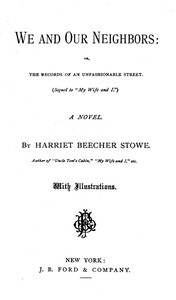
For We and Our Neighbors; or, The Records of an Unfashionable Street — A Reader’s Guide, the stored edition analysis reports 151,999 words, 11 hr 1 min estimated reading time, and 15 detected text sections.
The text analysis averages about 20.4 words per sentence, while the detected sections provide another way to judge how the source is divided.
Project Gutenberg metadata also associates the work with “American fiction -- 19th century,” connecting these edition facts with the source record’s subject description.
Explore this collection
These alternatives are selected using recorded categories and estimated reading time.
About 653 minutes
England London Nineteenth Century Fiction
150,144 recorded words. 8 minutes difference from this book's estimate.
View Gutenberg source #48296About 615 minutes
England London Nineteenth Century Fiction
141,302 recorded words. 46 minutes difference from this book's estimate.
View Gutenberg source #49331About 611 minutes
England London Nineteenth Century Fiction
140,390 recorded words. 50 minutes difference from this book's estimate.
View Gutenberg source #46857Search stored excerpts and compare books → Choose by your preferences →
Choices use stored catalog measurements. Estimates vary with reading speed. A shared category is a catalog label, not a claim that two books have the same argument or literary quality.
Search reads excerpt text stored with this catalog and links to its associated Gutenberg record. The connection is stored in the site database; this tool does not recheck that every excerpt is word-for-word identical to that external record. Excerpt search does not cover every chapter and does not verify historical publication dates.
Catalog snapshot checked: 2026-09-25. Coverage: 94 public books, 94 available source excerpts.
Read the complete public-domain text at its original source.
Read on Project GutenbergThe novel opens with a brisk little old lady peeping through window blinds, asking who has taken the Ferguses' house—a small, domestic question that immediately establishes the street-level curiosity and social scrutiny that will drive the narrative. Stowe frames the story as a record of an unfashionable street, signaling that the drama will be intimate and neighborly rather than grand. The first chapter, titled 'The Other Side of the Street,' suggests a world of contrasts and moral choices just across the way.
From the start, the reader is placed inside a household where women debate charity, prudence, and Christian duty. Eva, the young wife, argues with her mother about taking in a fallen woman named Maggie, while her Aunt Maria represents conventional caution. The dialogue is sharp and specific, revealing character through argument rather than description.
The excerpts show that Stowe builds her scenes almost entirely through conversation. The opening question—'Who can have taken the Ferguses' house?'—is answered not by narration but by the talk that follows. In the long excerpt between Eva and her mother, every character’s position emerges through what they say and how they say it. Eva is earnest and scriptural, invoking the parable of the Good Samaritan; her mother is easily swayed, 'always convinced by the last speaker'; Aunt Maria, though absent from the scene, is evoked as a forceful presence who 'roused a tempest in a teapot.'
This reliance on dialogue gives the novel a theatrical quality. Readers should pay attention to who speaks first, who interrupts, and who falls silent. The chapter titles—'The Family Dictator at Work,' 'Aunt Maria Rouses a Tempest in a Teapot'—promise that verbal sparring will be a central pleasure. Stowe uses talk not just to advance plot but to dramatize moral reasoning in real time.
Eva’s argument with her mother is the moral heart of the excerpt. She insists that helping a 'poor woman right under my own roof' is a Christian obligation, even if it brings trouble. Her mother worries about prudence: 'girls that have fallen into bad ways are such dangerous creatures.' Eva counters that failure is better than inaction: 'it's better to try and fail in doing our part for others than never to try at all.'
Stowe does not let the debate remain abstract. Eva mentions Maggie’s pride, her skill with a needle, and the danger of her mother 'bringing up old offenses.' These concrete details ground the ethical question in lived reality. The novel appears to test how far Christian charity can extend in a world of social reputation and family pressure. Readers should watch for how this tension between principle and practicality recurs in later chapters, especially those titled 'A Soul in Peril' and 'The Unprotected Female.'
Several chapter headings indicate that letters will be a key structural device: 'Eva to Harry's Mother' appears at least five times, and 'Bolton to Caroline' once. The excerpts do not include these letters, but their presence suggests that Stowe uses epistolary passages to reveal thoughts too private for dialogue, or to connect characters who are not in the same room.
The letter chapters are interspersed with action chapters—'Our First Thursday,' 'A Dinner on Washing Day'—creating a rhythm between reflection and event. Readers encountering the full text should note how the letters function: do they advance the plot, deepen character, or provide a counterpoint to the spoken arguments? The fact that Eva writes to Harry's mother (not her own) hints at a relationship that may be central to the story. The letters may also offer a more intimate voice than the sometimes combative dialogue.
The title insists on the street as a character. 'Unfashionable' is a deliberate choice: it signals that the novel will not be about high society but about the middle ground where respectability and need meet. The opening question about new neighbors establishes that who lives where matters. The table of contents includes chapters like 'The Other Side of the Street' and 'A Mistress Without a Maid,' suggesting that physical proximity forces moral encounters.
Stowe uses the street as a stage for social observation. The 'Records of an Unfashionable Street' implies a chronicle, almost documentary, of daily life. Readers should track how the street’s geography—houses, windows, doors—shapes interactions. The frontispiece illustration shows a woman peeping through blinds, a visual motif of watching and being watched. This scrutiny is both literal (neighbors observing) and figurative (the reader observing the characters’ choices). The novel seems to ask: what does it mean to live alongside others, especially those who are troubled or troubling?
As you read, attend to the rhythm of argument and letter, of domestic detail and moral crisis. Stowe’s dialogue rewards careful attention: each character’s speech reveals not just opinion but temperament. The novel is long—over 150,000 words—but its structure is episodic, built around set-piece conversations and events. Let the chapter titles guide you; they are often witty and pointed. And remember that the street itself is a character: watch how the unfashionable setting shapes what is possible and what is forbidden.
Some stories stay with you like a familiar street at dusk. The neighborly warmth and quiet moral weight in this one reminded me of another old book, where village life carries the same slow, patient honesty. I found myself thinking of Squire Arden; volume 1 of 3 — Context and Discussion afterward—not because they’re alike in plot, but because both left that same gentle ache of recognition.
Save your reaction, strongest insight, and memorable passage.