About 332 minutes
Patty's Perversities — Reading Companion
England London Nineteenth Century Fiction
76,173 recorded words. 0 minutes difference from this book's estimate.
View Gutenberg source #48396
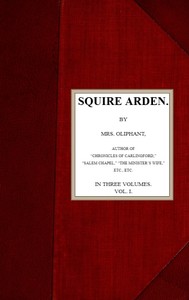
The catalog record for Squire Arden; volume 1 of 3 — Context and Discussion provides practical reading context through 76,270 words, 5 hr 32 min estimated reading time, and 7 detected text sections.
The text analysis averages about 18.2 words per sentence, while the detected sections provide another way to judge how the source is divided.
Project Gutenberg metadata also associates the work with “Inheritance and succession -- Fiction,” connecting these edition facts with the source record’s subject description.
Explore this collection
These alternatives are selected using recorded categories and estimated reading time.
About 332 minutes
England London Nineteenth Century Fiction
76,173 recorded words. 0 minutes difference from this book's estimate.
View Gutenberg source #48396About 339 minutes
England London Nineteenth Century Fiction
77,913 recorded words. 7 minutes difference from this book's estimate.
View Gutenberg source #54186About 323 minutes
England London Nineteenth Century Fiction
74,176 recorded words. 9 minutes difference from this book's estimate.
View Gutenberg source #47533Search stored excerpts and compare books → Choose by your preferences →
Choices use stored catalog measurements. Estimates vary with reading speed. A shared category is a catalog label, not a claim that two books have the same argument or literary quality.
Search reads excerpt text stored with this catalog and links to its associated Gutenberg record. The connection is stored in the site database; this tool does not recheck that every excerpt is word-for-word identical to that external record. Excerpt search does not cover every chapter and does not verify historical publication dates.
Catalog snapshot checked: 2026-09-25. Coverage: 94 public books, 94 available source excerpts.
Read the complete public-domain text at its original source.
Read on Project GutenbergThe first chapter of Squire Arden begins not with the squire himself but with a question: “What are the joy bells a-ringing for, Simon?” The answer—that the young squire has come home—arrives through the dialect-laced exchange between old Sarah and her brother, the clerk Simon Molyneaux. Mrs. Oliphant immediately establishes a village where news travels by voice and gesture, not by post. The narrator’s aside about Simon’s Lancashire speech—declining to reproduce every doubled vowel—signals a careful negotiation between regional authenticity and readerly ease.
The novel’s structure hinges on movement between domestic interiors and outdoor spaces, from the tidy cottage garden to the formal dining room of the Red House. In the dinner scene, Edgar Arden’s attempts at light conversation collide with Lord Newmarch’s earnestness on compulsory education, and with Alice’s shy, monosyllabic replies. The comedy arises from the gap between what characters say and what they feel—Edgar’s silent plea for “chitter-chatter” versus Alice’s unspoken willingness to say “Oh yes, Mr. Arden” all evening.
Mrs. Oliphant introduces Simon Molyneaux’s speech with a deliberate editorial comment: “What he really did say was ‘he’s coom whoam’; but the reader will be so kind as take it for granted that Simon was an old Lancashire man, and talked accordingly, without giving a pen not too familiar with the dialect the trouble of putting in all the o’s that are necessary.” This moment does more than excuse the author from phonetic transcription; it frames the novel’s attitude toward regional voice. The narrator treats dialect as a known quantity, something the reader can infer without full representation. The effect is to keep the story accessible while still marking the village as a place apart from standard literary English. Later, when Edgar Arden speaks, his language carries no such markers, setting him apart from the villagers even before his actions do.
The extended dinner scene at the Red House occupies a central structural position in the excerpts, moving the action from open-air village gossip to the constrained formality of a meal. Here, Mrs. Oliphant deploys a shifting focal point: the reader follows Edgar’s restless attention as it moves from Alice’s silence to Mrs. Buxton’s earnest debate with Lord Newmarch, then to Mrs. Pimpernel’s “cloud of uneasiness.” The table becomes a grid of competing conversational agendas—education, personal gossip, flirtation—each character locked into a role. Edgar’s remark, “I do not care anything about education… I hate it when I am at dinner,” is a tactical disruption, a friendly gun fired across the bows of politeness. The scene reveals how social performance constrains genuine exchange, a theme that recurs in the novel’s treatment of inheritance and duty.
From the opening description of Sarah’s “cheeks of a russet colour, half brown half red, yet soft, despite all their wrinkles” to Simon’s face “as full of cross-hatching as if he had been an old print,” Mrs. Oliphant builds a visual vocabulary grounded in texture and light. Sarah’s white apron “shone in the sun, and made the chief light in the little picture”; Simon’s eyes, though deep in wrinkled caves, retain “a spark of light.” These details do not merely decorate—they establish a way of seeing characters as composed of surfaces and inner lights. The same attention to appearance recurs in the dinner scene, where Mary Molyneaux’s teeth are described as “like pearls,” and Alice’s blush and choked cough become visible markers of interior states. The novel’s movement between outdoor brightness and indoor candlelight reinforces this pattern of observation.
The excerpts trace a clear spatial arc: from the cottage door, where Sarah and Simon stand “leaning his arms upon the little paling,” to the interior of the Red House dining room. This journey from open-air gossip to enclosed formality mirrors the novel’s larger concern with how public identity is constructed and managed. In the village, news of the young squire’s arrival is shared freely; at the dinner table, every remark is weighed. Edgar’s whispered question to Alice (“Do you admire Lord Newmarch very much?”) is an attempt to carve out a private exchange within a public setting, but Alice’s choked reply and dropped fork show how difficult that is. The novel’s structure depends on such thresholds: the garden gate, the dining-room door, the space between one character’s murmured confidence and another’s overheard remark.
Readers attentive to the novel’s opening will notice how Mrs. Oliphant uses the contrast between Simon’s dialect and Edgar’s standard English to establish a world where speech marks belonging. The dinner scene, with its layered interruptions and unspoken desires, rewards close attention to who speaks, who is silenced, and what gets said in the gaps. The first volume sets up a pattern of arrivals and returns—the squire’s homecoming, the dinner party’s formalities—that invites the reader to watch for how these movements shape the characters’ fates.
I’ve often lingered over Mrs. Oliphant’s quieter moments in Squire Arden, where every glance across a dinner table hides a whole history. It reminds me of that other novel, The Mutable Many: A Novel — Key Ideas to Explore, which also understands how much we don’t say aloud. Such a gentle, knowing companionship between old friends.
Answer a few questions and save a private reflection on this device.