About 317 minutes
Ann and Her Mother — A Closer Reading
England London Nineteenth Century Fiction
72,712 recorded words. 2 minutes difference from this book's estimate.
View Gutenberg source #53522
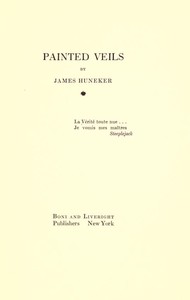
This digital edition of Painted Veils — Reading Notes is described by source-level measurements including 72,370 words, 5 hr 15 min estimated reading time, and 6 detected text sections.
The text analysis averages about 12.4 words per sentence, while the detected sections provide another way to judge how the source is divided.
Project Gutenberg metadata also associates the work with “American fiction -- 20th century,” connecting these edition facts with the source record’s subject description.
Explore this collection
These alternatives are selected using recorded categories and estimated reading time.
About 317 minutes
England London Nineteenth Century Fiction
72,712 recorded words. 2 minutes difference from this book's estimate.
View Gutenberg source #53522About 312 minutes
England London Nineteenth Century Fiction
71,669 recorded words. 3 minutes difference from this book's estimate.
View Gutenberg source #53049About 323 minutes
England London Nineteenth Century Fiction
74,176 recorded words. 8 minutes difference from this book's estimate.
View Gutenberg source #47533Search stored excerpts and compare books → Choose by your preferences →
Choices use stored catalog measurements. Estimates vary with reading speed. A shared category is a catalog label, not a claim that two books have the same argument or literary quality.
Search reads excerpt text stored with this catalog and links to its associated Gutenberg record. The connection is stored in the site database; this tool does not recheck that every excerpt is word-for-word identical to that external record. Excerpt search does not cover every chapter and does not verify historical publication dates.
Catalog snapshot checked: 2026-09-25. Coverage: 94 public books, 94 available source excerpts.
Read the complete public-domain text at its original source.
Read on Project GutenbergThe novel opens with an epigraph from the Babylonian epic of Istar, who is stripped of her ornaments and veil at seven gates before entering the land of the dead. This descent pattern is mirrored in the book's structure: each of the seven sections is titled after a gate, beginning with 'The First Gate.' The epigraph is followed by a list of 'The Seven Deadly Virtues'—Humility, Charity, Meekness, Temperance, Brotherly Love, Diligence, Chastity—and 'The Seven Deadly Arts'—Poetry, Music, Architecture, Painting, Sculpture, Drama, Dancing. This inversion of conventional morality signals that the novel will examine the tensions between artistic expression and social propriety.
The first chapter begins with Easter's arrival in New York: 'Until the day of her death Easter never forgot that first night in New York. It was the initial twist of her ship's wheel.' The language of navigation and fate suggests that a single moment can redirect a life. The journey from Washington is described as 'stupid,' and the city is approached through fog and snow. Easter's baggage is checked to a hotel, and she climbs into a hansom cab—details that ground the narrative in specific, tactile experience. The epigraph's stripping at the first gate (the tiara removed) finds a parallel in Easter's shedding of her former self as she enters the Maison Felicé, a boarding house that will 'give force and direction to her entire life.' The reader is left to infer what exactly is being stripped away: innocence, provincialism, or conventional identity.
Ulick, a central male character, reflects on the women in his life with a cynical economic vocabulary. He thinks of Dora as 'a commodity' and extends the metaphor: 'So is Paul. So am I—for Dora. So is Mona. We are all chattels of chance.' This passage, drawn from the excerpts, reveals a worldview in which human relationships are transactional. Dora's own philosophy is rendered in direct, colloquial speech: 'What's the difference between me and the poor dirty wife with a dozen brats? A woman is always kept by a man, wedding-ring or no.' The novel juxtaposes these blunt assessments with the romantic mystery surrounding Mona, who imposes strict rules on Ulick—no visiting, no revealing their friendship to her brother. The contrast between Dora's openness and Mona's secrecy creates a structural tension.
Mona remains largely absent from the excerpts, known only through Ulick's anxious speculation and the gossip of Alfred Stone. Ulick recalls her 'deep-set, passionate eyes' and decides she is 'oversexed' and 'likes to make herself not too easy.' He is forbidden to contact her directly, and when she disappears for ten days, he has 'no way of knowing the truth.' Alfred Stone reports that Mona and her mother have gone to Hot Springs, and that Mona is 'not in the best of health' and 'snappy.' The novel withholds Mona's perspective, making her a figure of desire and frustration. Her brother Milt is a seminary student, adding a religious dimension to the family background. The reader, like Ulick, must piece together Mona's character from fragments and secondhand reports.
The excerpts offer a world where women are both stripped and veiled, where art is listed among the deadly sins, and where every character is a chattel of chance. Readers attentive to the epigraph's seven gates will find a structural key: each gate may correspond to a chapter or a stage of undressing. The novel rewards close attention to its epigraphs, its inversions of virtue, and its unsentimental dialogue. Approach it as a series of unveilings—of character, of motive, of the city itself.
Easter’s veils, those gilded deceptions, always made me think of how stories hide their seams. Huneker’s restless New York finds a quieter echo in Jaunty Jock, and Other Stories — Story, Setting & Ideas, where raw motives surface without grand opera. Both trust the reader to see through. I’ve shelved them together for years now, old friends, never arguing.
Create a short personal record of your experience with this book.