About 317 minutes
Ann and Her Mother — A Closer Reading
England London Nineteenth Century Fiction
72,712 recorded words. 6 minutes difference from this book's estimate.
View Gutenberg source #53522
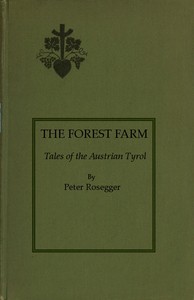
The Forest Farm: Tales of the Austrian Tyrol — Edition Insights can be approached with a clearer sense of reading commitment from its source measurements: 74,176 words, 5 hr 23 min estimated reading time, and 24 detected text sections.
The text analysis averages about 20.2 words per sentence, while the detected sections provide another way to judge how the source is divided.
Project Gutenberg metadata also associates the work with “Historical fiction,” connecting these edition facts with the source record’s subject description.
Explore this collection
These alternatives are selected using recorded categories and estimated reading time.
About 317 minutes
England London Nineteenth Century Fiction
72,712 recorded words. 6 minutes difference from this book's estimate.
View Gutenberg source #53522About 315 minutes
England London Nineteenth Century Fiction
72,370 recorded words. 8 minutes difference from this book's estimate.
View Gutenberg source #47141About 332 minutes
England London Nineteenth Century Fiction
76,173 recorded words. 9 minutes difference from this book's estimate.
View Gutenberg source #48396Search stored excerpts and compare books → Choose by your preferences →
Choices use stored catalog measurements. Estimates vary with reading speed. A shared category is a catalog label, not a claim that two books have the same argument or literary quality.
Search reads excerpt text stored with this catalog and links to its associated Gutenberg record. The connection is stored in the site database; this tool does not recheck that every excerpt is word-for-word identical to that external record. Excerpt search does not cover every chapter and does not verify historical publication dates.
Catalog snapshot checked: 2026-09-25. Coverage: 94 public books, 94 available source excerpts.
Read the complete public-domain text at its original source.
Read on Project GutenbergIn the excerpt from "The Corpus Christi Altar," a young boy—likely the author's stand-in—nervously confesses to a priest that he once played cards on the altar. The priest's reaction is not wrath but a wry inquiry into intent, followed by an invitation for more coffee. This moment encapsulates the collection's tone: moral gravity leavened by earthy humor and a keen eye for the gap between religious rule and human reality. The story is one of nineteen in The Forest Farm, a volume that blends memoir, folklore, and vignettes of Tyrolean peasant life.
The book credits six translators—M. E. King, A. T. de Mattos, Louise Evers, Ethel Blount, L. G., and L. Swietokowski—yet the excerpts read with a consistent plainness. The dialogue retains dialect markers: Cap Casimir speaks in a "sloppy brogue" with dropped consonants ("It'sh like thish"). The narrative voice, whether describing a stolen-trout scheme or a dying wife's bequest of goats, stays direct and slightly wry. This uniformity suggests either careful editorial oversight or a shared fidelity to Rosegger's original German. Readers may note how the translated idioms—"star-pricker" for a pointed hat, "his reverence" for the priest—anchor the stories in a specific cultural landscape without exoticizing it.
The narrator's moral calculus is precise: he weighs the Blasler boy's fish-theft against his own altar-card game, worrying that his might be "a sin against the Holy Ghost" and thus unforgivable. The priest, however, dismisses the boy's self-flagellation once he confirms no malicious intent. This pattern recurs in the goat episode: a widow leaves her livestock to the priest for masses, and the narrator times his confession to catch the priest in a good mood. The stories treat confession as a social transaction as much as a sacrament—a negotiation between peasant cunning and clerical authority, where a full udder or a cup of coffee can smooth the path to absolution.
Though the excerpts do not describe the forest in detail, the title and catalog subjects place the stories in the Tyrolean woods. The setting is not picturesque but functional: the fish-pond, the road where Casimir drives his goats, the priest's house with its coffee and fresh milk. Nature is a source of livelihood and temptation—the stolen trout, the unlicensed fishing. The forest farm itself, depicted in the frontispiece by Melicent Norris, likely serves as a hub for these tales. The collection's structure, moving from "My Father and I" to "About my Mother," suggests a life shaped by the rhythms of a mountain homestead, where every moral question has a practical edge.
Readers approaching The Forest Farm should expect not a novel but a cycle of linked episodes, each complete yet cumulative. The multiple translators and varied sources (some stories first appeared in periodicals) mean the tone may shift slightly from piece to piece. Pay attention to the recurring figures—the priest, the parents, the boy narrator—and to the way Rosegger lets small misdeeds open onto larger questions of community, faith, and survival. The forest is never far away, but neither is the laughter.
That Rosegger book stayed with me like woodsmoke on wool—those confessional scrapes, the priest’s shrug of grace. It made me think how quiet belief hums beneath unpolished days. I wonder sometimes if Sons of the Morning — Key Ideas to Explore carries that same earthy mercy, that slow forgiveness folded into ordinary light.
Your answers remain private and are stored only in this browser.