About 154 minutes
Foxglove Manor: A Novel, Volume 3 (of 3) — Inside the Classic
England London Nineteenth Century Fiction
35,224 recorded words. 8 minutes difference from this book's estimate.
View Gutenberg source #48473
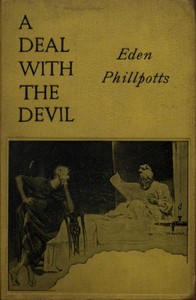
The source record for A Deal with the Devil — A Reader’s Guide measures this digital text at 37,175 words, 2 hr 42 min estimated reading time, and 6 detected text sections.
The text analysis averages about 14.8 words per sentence, while the detected sections provide another way to judge how the source is divided.
Project Gutenberg metadata also associates the work with “England -- Social life and customs -- 19th century -- Fiction,” connecting these edition facts with the source record’s subject description.
Explore this collection
These alternatives are selected using recorded categories and estimated reading time.
About 154 minutes
England London Nineteenth Century Fiction
35,224 recorded words. 8 minutes difference from this book's estimate.
View Gutenberg source #48473About 171 minutes
England London Nineteenth Century Fiction
39,255 recorded words. 9 minutes difference from this book's estimate.
View Gutenberg source #51944About 137 minutes
England London Nineteenth Century Fiction
31,395 recorded words. 25 minutes difference from this book's estimate.
View Gutenberg source #51928Search stored excerpts and compare books → Choose by your preferences →
Choices use stored catalog measurements. Estimates vary with reading speed. A shared category is a catalog label, not a claim that two books have the same argument or literary quality.
Search reads excerpt text stored with this catalog and links to its associated Gutenberg record. The connection is stored in the site database; this tool does not recheck that every excerpt is word-for-word identical to that external record. Excerpt search does not cover every chapter and does not verify historical publication dates.
Catalog snapshot checked: 2026-09-25. Coverage: 94 public books, 94 available source excerpts.
Read the complete public-domain text at its original source.
Read on Project GutenbergMartha Dolphin, the narrator and granddaughter of the hundred-year-old Daniel Dolphin, introduces her grandfather as a man who has buried three wives and all five of his children, and who served five years for forgery. She claims that from age ninety-five he reformed, thanks to her warnings and the Rev. John Murdoch's ministrations. The opening chapter establishes a tone of wry moral commentary, with Martha describing her grandfather as a 'perfect picture' for a miser rather than a venerable elder.
The story is told in the first person by Martha, who presents herself as the sole surviving descendant and the guardian of her grandfather's soul. Her language is precise and often ironic: she notes that grandpapa 'kept as sober, as honest, and as innocent as one could wish to see any nonagenarian.' This phrasing undercuts the praise by reminding the reader of his earlier crimes. Martha's control over the narrative is evident when she describes her visit to the Crystal Palace to observe Susan Marks. She reports the conversation she overhears verbatim, allowing the reader to judge Susan's character directly. Martha's own reactions—'my blood boiled'—are stated plainly, reinforcing her role as the moral center. The excerpts do not reveal whether Martha's perspective is reliable or whether her interventions are entirely altruistic.
The catalog subjects include 'Devil -- Fiction' and 'Rejuvenation -- Fiction,' yet the excerpts contain no explicit supernatural elements. The title suggests a Faustian bargain, but the text so far presents only human schemes: Daniel Dolphin's plan to marry a young woman, and Martha's efforts to thwart him. The word 'devil' appears only in the title and chapter headings; within the narrative, grandpapa's 'rejuvenation' is merely his romantic interest at age one hundred. The catalog may imply a literal diabolical pact, but the excerpts show a comic, domestic story of deception and family intrigue. Readers should note that the supernatural may emerge later, or the 'deal' may be purely metaphorical.
The setting is late nineteenth-century England, with specific locations: the Crystal Palace, Lady Godiva's statue, and a chocolate stall. Susan Marks works as a seller of 'sweetstuff,' and her speech is marked by slang ('mash,' 'bangle,' 'fal-lals') and a hard, mercenary tone. Martha, by contrast, uses more formal language and refers to 'the Squire's daughter' and 'Upper Norwood.' The contrast in diction highlights class differences. Grandpapa's past as a forger and his current pursuit of a 'model girl' from the lower classes suggest a social fluidity that the catalog subject 'England -- Social life and customs -- 19th century' captures, but the excerpts focus on individual transactions rather than broad customs.
Readers should attend to how the title's promise of a diabolical deal is fulfilled—or subverted—as the narrative progresses. The excerpts end before any explicit pact appears, leaving open whether the devil is literal or a figure for human folly. Martha's voice dominates, but her reliability may be tested by later events. The novel's short length (under 40,000 words) suggests a brisk, focused plot.
That rainy afternoon, A Deal with the Devil left me thinking about how family stories get tangled with what we choose not to see. Martha’s careful unravelling of her grandfather’s romance felt less like comedy and more like a quiet warning. Afterwards, I found myself reaching for Ann and Her Mother — A Closer Reading, wondering how another daughter’s loyalty might bend under the weight of similar secrets.
Answer a few questions and save a private reflection on this device.