About 615 minutes
The Young Physician — Themes and Context
England London Nineteenth Century Fiction
141,302 recorded words. 4 minutes difference from this book's estimate.
View Gutenberg source #49331
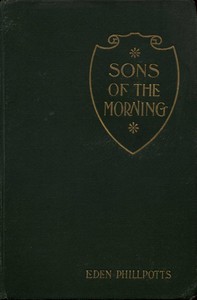
The catalog record for Sons of the Morning — Key Ideas to Explore provides practical reading context through 140,390 words, 10 hr 11 min estimated reading time, and 17 detected text sections.
The text analysis averages about 17.0 words per sentence, while the detected sections provide another way to judge how the source is divided.
Project Gutenberg metadata also associates the work with “Triangles (Interpersonal relations) -- Fiction,” connecting these edition facts with the source record’s subject description.
Explore this collection
These alternatives are selected using recorded categories and estimated reading time.
About 615 minutes
England London Nineteenth Century Fiction
141,302 recorded words. 4 minutes difference from this book's estimate.
View Gutenberg source #49331About 583 minutes
England London Nineteenth Century Fiction
133,976 recorded words. 28 minutes difference from this book's estimate.
View Gutenberg source #47640About 653 minutes
England London Nineteenth Century Fiction
150,144 recorded words. 42 minutes difference from this book's estimate.
View Gutenberg source #48296Search stored excerpts and compare books → Choose by your preferences →
Choices use stored catalog measurements. Estimates vary with reading speed. A shared category is a catalog label, not a claim that two books have the same argument or literary quality.
Search reads excerpt text stored with this catalog and links to its associated Gutenberg record. The connection is stored in the site database; this tool does not recheck that every excerpt is word-for-word identical to that external record. Excerpt search does not cover every chapter and does not verify historical publication dates.
Catalog snapshot checked: 2026-09-25. Coverage: 94 public books, 94 available source excerpts.
Read the complete public-domain text at its original source.
Read on Project GutenbergThe novel begins not with a character or action but with a tree: a beech described in painstaking botanical and aesthetic detail. Its trunk is 'moss-grown,' its leaves 'a dapple of dull silver,' and its branches 'rippling to earth like a waterfall.' This opening announces a narrator who sees landscape as a living system, not mere backdrop. The tree is 'queen of the wold,' and the prose lingers on lichen, boulders, and the 'wan seed-vessels of bygone bluebells.'
Yet this lyrical mode is immediately counterpointed by the dialogue of servants like Churdles Ash and Henry Collins. When Honor is taken ill in childbirth, the men discuss the event in broad Devon dialect: 'Theer's the douce of a upstore down house.' Their earthy humour—'Rise up be damned!'—and talk of birth-timing as a predictor of character create a vernacular realism that undercuts the opening's high style. Phillpotts thus sets two registers in tension from the first chapters.
The opening chapter, 'The Beech Tree,' devotes over a page to a single tree before any human appears. The prose is almost scientific in its attention: the tree's 'special symmetry,' its 'midmost boughs' that 'tended from the horizontal gradually downward,' and the 'dragon shapes' of its roots. This is not mere scene-setting; the beech becomes a presiding presence. Later, when Honor is frightened by moonlight in the woods, her husband Myles reassures her that 'Half the terror was in your mind, and half in the pranks of the moonlight among the trees.' The natural world is both beautiful and threatening, a duality the novel sustains.
Phillpotts's descriptive method is accumulative: he piles up details of 'melampyre,' 'seed-vessels,' 'etiolate things,' and 'mossy boulders' to create a dense, almost tactile environment. This technique recurs throughout the excerpts, suggesting a world where human drama is embedded in a larger ecological order. The tree is not a symbol but a co-inhabitant of the story's space.
When Honor goes into labour, the narrative shifts abruptly to the attic bedroom of Henry Collins and Churdles Ash. Their conversation is rendered in thick Devon dialect: 'a proper tantara,' 'gwaine on,' 'the twoads be mostly tu forrard or tu back'ard.' Phillpotts does not condescend to these characters. Churdles's refusal to rise—'Rise up be damned!'—is followed by a tender qualification: 'Not that I wouldn't rise up to the moon if I could take the leastest twinge off of her.' The dialect is not comic relief but a vehicle for genuine feeling and folk wisdom.
Collins's question about Churdles's own birth—'How was you with regards to the reckoning?'—prompts a playful exchange about punctuality and character. This moment of male banter during a crisis of childbirth reveals how the novel uses vernacular speech to explore themes of fate, timing, and human nature. The servants are not background; they offer a counterpoint to the more refined anxieties of the main characters.
Chapter VI, 'Sorrow's Face,' reveals that the same night Honor gives birth, the old mother of Gregory Libby dies. Doctor Mathers is 'torn in two between a birth-bed and a death-bed.' The juxtaposition is stark and deliberate. The death occurs 'at a moment of great peace before the dawn,' while the birth is attended by the same physician, who then 'dragged his weary limbs up the hill again.'
This structural pairing—life arriving as another life departs—is handled without sentimentality. The narrative reports the events plainly: 'when she had passed, while her son yet stared in fear from the foot of the bed.' The focus is on the doctor's exhaustion and the simultaneity of joy and grief. Phillpotts does not moralize; he lets the coincidence speak for itself. The chapter title, 'Sorrow's Face,' hints at the emotional weight, but the prose remains restrained, trusting the reader to feel the symmetry.
Beyond dialect, Phillpotts attends to the rhythms of rural conversation: its repetitions, its understatement, its reliance on shared knowledge. When Honor says, 'I'm not very well, dear Myles. I'm—indeed I think baby's going to be born to-night,' the hesitation and the word 'think' convey her uncertainty and pain without melodrama. Myles's response—'He ran to the physician's little dwelling'—is all action, no speech.
Similarly, the servants' dialogue is full of proverbial wisdom: 'The sacred dooty of child-bearin' be now gwaine on, an' at such times even the faither hisself awnly looks a fule.' This is not just local colour; it is a worldview. The novel's language shifts between the lyrical and the colloquial, but both registers are treated with equal seriousness. The result is a textured social landscape where every character, from the beech tree to the sexton's wife, has a voice.
Readers attentive to diction will find that Phillpotts's Devon is not a pastoral idyll but a place where beauty and pain coexist in the same sentence. The novel rewards those who listen to its shifts in register—from the elaborate cadences of nature description to the blunt, affectionate speech of the farmhouse. Approach it as a study in voice and landscape, not as a plot-driven romance. The excerpts suggest a work that earns its length through patient accumulation of detail and a refusal to simplify the textures of rural life.
I remember those beech trees in Sons of the Morning, how Phillpotts lingered on their great limbs, then turned abruptly to the midwife’s coarse jokes. That swing between awe and plainness stayed with me, like a held breath finally released. Something in that contrast made me think of a little guide, Tales of two people — A Reader’s Guide, which traces similar quiet shifts between two lives on one page, no fanfare, just noticing.
Create a short personal record of your experience with this book.