About 384 minutes
The Paper Cap: A Story of Love and Labor — Context and Discussion
England London Nineteenth Century Fiction
88,214 recorded words. 17 minutes difference from this book's estimate.
View Gutenberg source #50089
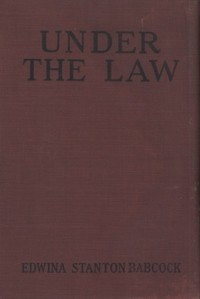
For Under the Law — A Reader’s Guide, the stored edition analysis reports 92,147 words, 6 hr 41 min estimated reading time, and 10 detected text sections.
The text analysis averages about 16.6 words per sentence, while the detected sections provide another way to judge how the source is divided.
Project Gutenberg metadata also associates the work with “Young women -- Fiction,” connecting these edition facts with the source record’s subject description.
Explore this collection
These alternatives are selected using recorded categories and estimated reading time.
About 384 minutes
England London Nineteenth Century Fiction
88,214 recorded words. 17 minutes difference from this book's estimate.
View Gutenberg source #50089About 379 minutes
England London Nineteenth Century Fiction
87,017 recorded words. 22 minutes difference from this book's estimate.
View Gutenberg source #46520About 379 minutes
England London Nineteenth Century Fiction
86,958 recorded words. 22 minutes difference from this book's estimate.
View Gutenberg source #51969Search stored excerpts and compare books → Choose by your preferences →
Choices use stored catalog measurements. Estimates vary with reading speed. A shared category is a catalog label, not a claim that two books have the same argument or literary quality.
Search reads excerpt text stored with this catalog and links to its associated Gutenberg record. The connection is stored in the site database; this tool does not recheck that every excerpt is word-for-word identical to that external record. Excerpt search does not cover every chapter and does not verify historical publication dates.
Catalog snapshot checked: 2026-09-25. Coverage: 94 public books, 94 available source excerpts.
Read the complete public-domain text at its original source.
Read on Project GutenbergThe opening chapter of Under the Law introduces Sard Bogart driving through a March-thawed Hudson Valley town, where she stops to investigate a crowd jeering at a heap in the gutter. The victim is a tramp who claims not to know who he is—a detail the postman dismisses as a tramp's ruse. Sard's intervention sets up a central tension: the gap between official authority (the authorities have gone home to dinner) and individual responsibility. The prose is brisk, with sensory details like the wet smell of spring and the river's ethereal light, but the social landscape is harsher, marked by loafers, shamefaced townspeople, and a casual cruelty that Sard challenges.
The excerpts showcase a range of vernacular speech that distinguishes characters by class and region. The postman's rambling explanation—'Ef he's drunk, it's a new kind of drunk. Vanilla extract, they tell me, is what this kind boozes on nowadays'—is both folksy and dismissive. Later, the dialogue among the young people at the creek is laced with period slang: 'moving-picture Polly,' 'cute candy with the Chinks,' and 'the Hackensack Backwaters.' Tawny Troop's oratorical bluster contrasts with Dunstan's raw fury, while Gertrude's hard laugh and sharp whispers reveal a social pecking order. The river itself is a constant presence, from the shadmen's stakes to the wobbling canoe, grounding the verbal sparring in a specific landscape.
The tramp's claim of lost identity—'trying to pertend he don't know who he is'—is treated by the townspeople as a transparent lie, but the novel's title and epigraph from Galatians ('But if ye be led of the Spirit ye are not under the law') suggest a deeper inquiry into guilt and innocence. The excerpts do not reveal whether the man is truly an amnesiac or a fraud, but his condition forces Sard and others to choose between legalistic judgment and compassionate action. The postman's shrug—'that ain't hard for a tramp; ain't nobody anyhow'—encapsulates a worldview that the narrative seems to challenge. The later scene at the creek, with its drugged candy and accusations, echoes this theme: characters are judged by their actions, but the law (social or legal) is shown as inadequate.
The creek-side party is a theater of status and hypocrisy. Tawny Troop, the 'Exquisite,' performs wealth with his monogrammed sweater and gold tank, while Dunstan's rage is fueled by a sense of degradation: 'Dunstan, out of a very clean straightforward heritage, felt somehow vulgarized, degraded.' Gertrude's whispered warning to Cinny—'we'll have to see that we are not any sportier than they are'—reveals a code of appearances that governs the group. The ukulele, the cushions, the candy box tossed into the creek: these props underscore a world where reputation is a fragile performance. Sard and Minga, though absent from this scene, are invoked as arbiters of respectability, suggesting that the novel will explore how different characters navigate these unwritten laws.
Readers attentive to the novel's title and epigraph will find a sustained meditation on the gap between legal codes and moral ones. The excerpts offer no resolution to the tramp's mystery or the party's fallout, but they establish a world where every action—a jeer, a rescue, a whispered warning—carries weight. Pay particular attention to how Babcock uses setting: the thawing roads, the river, and the 'squalidness' of the creek all mirror the characters' moral terrain.
That rainy afternoon, Under the Law left me sitting with Sard’s quiet stubbornness, how she held onto a stranger’s humanity against the town’s tidy verdicts. The gray light blurred the pages, and I found myself drifting to another forgotten story about a woman’s loyalty tested by hunger and appetite — Madame Gilbert's Cannibal — Reading Notes — and the echoes felt almost accidental, like two women whispering across decades.
Save your reaction, strongest insight, and memorable passage.