About 379 minutes
Secret Service; or, Recollections of a City Detective — Edition Insights
England London Nineteenth Century Fiction
87,017 recorded words. 1 minutes difference from this book's estimate.
View Gutenberg source #46520
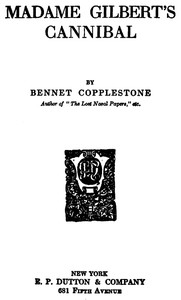
The catalog record for Madame Gilbert's Cannibal — Reading Notes provides practical reading context through 86,844 words, 6 hr 18 min estimated reading time, and 8 detected text sections.
The text analysis averages about 15.9 words per sentence, while the detected sections provide another way to judge how the source is divided.
Project Gutenberg metadata also associates the work with “Inheritance and succession -- Fiction,” connecting these edition facts with the source record’s subject description.
Explore this collection
These alternatives are selected using recorded categories and estimated reading time.
About 379 minutes
England London Nineteenth Century Fiction
87,017 recorded words. 1 minutes difference from this book's estimate.
View Gutenberg source #46520About 379 minutes
England London Nineteenth Century Fiction
86,958 recorded words. 1 minutes difference from this book's estimate.
View Gutenberg source #51969About 384 minutes
England London Nineteenth Century Fiction
88,214 recorded words. 6 minutes difference from this book's estimate.
View Gutenberg source #50089Search stored excerpts and compare books → Choose by your preferences →
Choices use stored catalog measurements. Estimates vary with reading speed. A shared category is a catalog label, not a claim that two books have the same argument or literary quality.
Search reads excerpt text stored with this catalog and links to its associated Gutenberg record. The connection is stored in the site database; this tool does not recheck that every excerpt is word-for-word identical to that external record. Excerpt search does not cover every chapter and does not verify historical publication dates.
Catalog snapshot checked: 2026-09-25. Coverage: 94 public books, 94 available source excerpts.
Read the complete public-domain text at its original source.
Read on Project GutenbergFrom its first chapter, Madame Gilbert's Cannibal establishes a protagonist who treats national borders and officialdom as inconveniences to be trampled. The narrator reports that Madame Gilbert 'never trouble[s] much about passports or credentials,' carrying a .25 automatic pistol as a backup. This offhand detail signals a world where personal force and charm override bureaucratic procedure. The novel's early pages also introduce a recurring structural pattern: a character's self-assessment is immediately undercut by the narrator's cooler judgment. Madame Gilbert believes she and her colleagues 'really won the war' on the Italian Front; the narrator follows with a flat statement: 'She is never grateful for service.' This tension between a character's grand self-image and the narrator's deflation runs through the excerpts.
The title's 'cannibal' is Willatopy, a Melanesian islander who calls the English cannibals. When a lawyer, John Clifford, arrives to claim he is a lord entitled to English estates, Willatopy drives him off with a fish spear, explaining: 'The English are all Cannibals.' This inversion—the colonized figure accusing the colonizers of the very savagery attributed to him—is the novel's sharpest satirical move. Willatopy's reasoning is precise: a stranger offering to secure 'rights' for no personal gain must be a predator. His father taught him that 'the English devoured one another.' The excerpts do not reveal whether Willatopy is correct about the lawyer's motives, but his suspicion is grounded in a coherent worldview. Madame Gilbert, despite her contempt for Clifford, does not correct Willatopy's belief; she instead admires his 'instinct for vermin.' The novel thus leaves the moral weight of 'cannibal' suspended between literal and figurative meanings.
Madame Gilbert dominates every excerpt in which she appears through a combination of theatrical wit and physical authority. When Clifford cowers behind her, she mocks him: 'Get behind me, British officer. I have no skirts for your protection.' The line plays on gender expectations while asserting her own fearlessness. She does not intervene to stop Willatopy from throwing Clifford into the water; she watches and comments. Her language mixes operatic scorn ('You poor worm a British officer') with a sardonic politeness that keeps others off balance. Yet the narrator also notes limits to her power: she cannot prevent Clifford's arrival, and her offer of a handshake is conditional on his departure. The excerpts suggest that Madame Gilbert's authority is performative and situational, dependent on the compliance of those around her. Whether this holds across the full novel is not clear from the text provided.
The excerpts repeatedly juxtapose legal claims with violent physical action. Clifford introduces himself as 'managing clerk to Chudleigh, Caves, Caves, and Chudleigh, solicitors'—a name that piles up legal authority. Willatopy's response is to chase him with a fish spear, leaving him 'covered with my jabs under that black coat.' The lawyer's body becomes a document of his failed mission. Later, Willatopy throws Clifford into the sea, reducing his 'damaged clothes' to 'irreparable' condition. The novel seems to stage a contest between paper rights and bodily presence: Clifford arrives with a story about inheritance and lordship; Willatopy counters with immediate, physical dominion over Tops Island. Madame Gilbert mediates between these poles, recognizing the force of Willatopy's claim while acknowledging the legal machinery Clifford represents. The excerpts do not resolve this tension, leaving the reader to wonder whether the 'rights' Clifford offers are genuine or predatory.
Readers should attend to the novel's use of nested narratives: Willatopy's account of his father's warnings, Clifford's legal tale, and the narrator's own judgments create competing frames of authority. The excerpts offer no resolution to the inheritance plot or to Willatopy's fate in England. What is visible is a pattern of reciprocal suspicion—each character views the other as potential devourer. The novel's interest lies less in who is right than in how each party constructs a story that justifies their actions.
That rainy afternoon, Madame Gilbert's Cannibal left me thinking about how ownership gets asserted through stories, how the legal claim and the human claim rarely align. Later, idly shelving books, I pulled down The Paper Cap: A Story of Love and Labor — Context and Discussion and found the same quiet friction, only closer to home. Both books kept me company until the light dimmed.
Save your reaction, strongest insight, and memorable passage.