About 379 minutes
Secret Service; or, Recollections of a City Detective — Edition Insights
England London Nineteenth Century Fiction
87,017 recorded words. 5 minutes difference from this book's estimate.
View Gutenberg source #46520
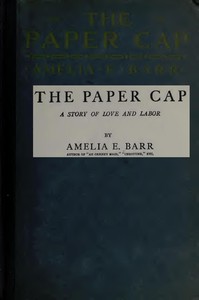
The catalog record for The Paper Cap: A Story of Love and Labor — Context and Discussion provides practical reading context through 88,214 words, 6 hr 24 min estimated reading time, and 10 detected text sections.
The text analysis averages about 16.4 words per sentence, while the detected sections provide another way to judge how the source is divided.
Project Gutenberg metadata also associates the work with “England -- Social life and customs -- 19th century -- Fiction,” connecting these edition facts with the source record’s subject description.
Explore this collection
These alternatives are selected using recorded categories and estimated reading time.
About 379 minutes
England London Nineteenth Century Fiction
87,017 recorded words. 5 minutes difference from this book's estimate.
View Gutenberg source #46520About 379 minutes
England London Nineteenth Century Fiction
86,958 recorded words. 5 minutes difference from this book's estimate.
View Gutenberg source #51969About 378 minutes
England London Nineteenth Century Fiction
86,844 recorded words. 6 minutes difference from this book's estimate.
View Gutenberg source #54865Search stored excerpts and compare books → Choose by your preferences →
Choices use stored catalog measurements. Estimates vary with reading speed. A shared category is a catalog label, not a claim that two books have the same argument or literary quality.
Search reads excerpt text stored with this catalog and links to its associated Gutenberg record. The connection is stored in the site database; this tool does not recheck that every excerpt is word-for-word identical to that external record. Excerpt search does not cover every chapter and does not verify historical publication dates.
Catalog snapshot checked: 2026-09-25. Coverage: 94 public books, 94 available source excerpts.
Read the complete public-domain text at its original source.
Read on Project GutenbergAmelia E. Barr opens The Paper Cap with an extended meditation on headgear as a symbol, tracing the paper cap's emergence during the Reform Bill agitation. This introductory essay, distinct from the novel proper, establishes a documentary tone that recurs throughout: the narrator frequently pauses to explain working-class customs, from cap-making to tea-drinking rituals. The dedication to Samuel Gompers signals the book's labor advocacy, yet the story itself centers on Dick Annis, a young man torn between love and ambition. Barr's prose moves between brisk exposition and leisurely description, especially when rendering Faith Foster's domestic sphere—her 'beautiful white arms and hands among the white china' become a recurring motif of purity and order.
The novel's title object receives a thorough unpacking in the opening pages. Barr describes the cap as 'square, straight, upright,' with no brim, allowing full sight and adding height. It is 'cool, light and clean,' made from a small square of brown paper that costs nothing. The author notes that every man makes his own cap, often while smoking his first morning pipe. This practical description gives way to a semiotics of posture: worn straight, the cap imparts a 'steady, business-like appearance'; tilted, it shows interest in appearance; pushed back, it signals worry. Employers 'readily understood its language.' Barr's attention to this detail grounds the novel's labor theme in a tangible object, one that reappears as a marker of class identity and personal dignity.
Dick Annis's courtship of Faith Foster occasions a notable change in tempo. Early passages move briskly through London distractions, but when Dick visits Faith's home, the narrative slows to dwell on sensory details: the 'clean tablecloth and some napkins,' the 'handsome silver tea service,' the 'broiled trout' brought by a neighbor. Barr renders the moment of mutual recognition in abstract, almost philosophical language: 'love is a state of the soul; anger, grief and other passions can change their mental states; but love? No!' This shift from action to introspection marks a recurring pattern—the novel alternates between social commentary and romantic interiority, with the latter often halting the former's momentum.
Barr's narrator frequently steps forward to offer moral or historical glosses. The opening essay on headgear is the most extended example, but similar asides appear throughout: a comment on fishing being 'apostolical,' a reflection on coincidences 'suggested or induced by the angel that guards our life and destiny.' These interventions give the novel a lecturing quality, as if the author is addressing a reader unfamiliar with working-class life. Yet the voice also carries warmth, especially in descriptions of Faith's 'homely sweetness' and Dick's realization that 'the Key to Life' lies 'in the Heart, and not in the Brain.' The tension between instruction and empathy defines the narrative's uneven but earnest register.
Readers should note that the excerpts cover only the novel's opening and early romantic scenes; the full 88,000-word text likely develops the labor plot hinted at in the dedication. Barr's habit of interrupting story for commentary means the pace varies considerably. Pay attention to how the paper cap itself appears—or disappears—as the narrative progresses, and whether the symbolic weight shifts from object to idea.
Reading The Paper Cap, I kept thinking of quiet kitchens and unspoken sacrifices, its earnest voice lingering like afternoon light. That same gentle gravity hums beneath another story I once cherished, where a daughter watches her mother’s hands at work. There is no grand drama, only small, tender recognitions that stay with you—much like this one: Ann and Her Mother — A Closer Reading. Both feel like old friends’ recollections.
Create a short personal record of your experience with this book.