About 556 minutes
Light-Fingered Gentry — Themes and Context
England London Nineteenth Century Fiction
127,723 recorded words. 17 minutes difference from this book's estimate.
View Gutenberg source #48621
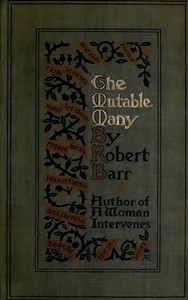
The source record for The Mutable Many: A Novel — Key Ideas to Explore measures this digital text at 123,906 words, 8 hr 59 min estimated reading time, and 14 detected text sections.
The text analysis averages about 16.9 words per sentence, while the detected sections provide another way to judge how the source is divided.
Project Gutenberg metadata also associates the work with “London (England) -- Fiction,” connecting these edition facts with the source record’s subject description.
Explore this collection
These alternatives are selected using recorded categories and estimated reading time.
About 556 minutes
England London Nineteenth Century Fiction
127,723 recorded words. 17 minutes difference from this book's estimate.
View Gutenberg source #48621About 521 minutes
England London Nineteenth Century Fiction
119,748 recorded words. 18 minutes difference from this book's estimate.
View Gutenberg source #52729About 512 minutes
England London Nineteenth Century Fiction
117,583 recorded words. 27 minutes difference from this book's estimate.
View Gutenberg source #48685Search stored excerpts and compare books → Choose by your preferences →
Choices use stored catalog measurements. Estimates vary with reading speed. A shared category is a catalog label, not a claim that two books have the same argument or literary quality.
Search reads excerpt text stored with this catalog and links to its associated Gutenberg record. The connection is stored in the site database; this tool does not recheck that every excerpt is word-for-word identical to that external record. Excerpt search does not cover every chapter and does not verify historical publication dates.
Catalog snapshot checked: 2026-09-25. Coverage: 94 public books, 94 available source excerpts.
Read the complete public-domain text at its original source.
Read on Project GutenbergThe novel opens with a striking image: the office of Monkton & Hope's factory hangs between two brick buildings, a wooden afterthought born of necessity. Manager John Sartwell looks out at a fog-shrouded yard, the earth represented by a sticky black-cindered surface bearing the imprint of many boots. This setting immediately establishes a world where industry and atmosphere intermingle, and where the office—described as the soul of the whole thing—is physically detached from the body of the works.
Barr's prose is precise and sensory, grounding the narrative in tangible details: the vibration-free wooden structure, the view of both front and back yards, and the fog that hesitates to fall. The factory is not merely a backdrop but a character in itself, shaping the lives and movements of those within its orbit.
The opening chapter of The Mutable Many offers a vivid portrait of industrial London. The office of Monkton & Hope's factory is described as hanging between heaven and earth, with heaven represented by a brooding London fog and earth by a sticky black-cindered yard. This vertical division mirrors the social stratification that runs through the novel. The office itself is a wooden addition, an afterthought connecting two brick buildings like Siamese twins of industry. Barr emphasizes the office's unique situation: it commands views of both front and back yards, enjoys more light and air than the previous office, and is free from the vibration of machinery. This careful attention to physical space reflects the author's interest in how environment shapes experience. The description is not merely functional; it carries symbolic weight, suggesting a precarious balance between the lofty and the grounded, the clean and the grimy.
Barr uses dialogue to delineate class and character with precision. In one excerpt, the aristocrat Barney speaks in a casual, self-deprecating manner, using phrases like "don't you know" and "I'll arrive some of these days." His speech is peppered with affectations: he claims to push others forward while neglecting his own interests, and he asserts that great men come from the common people, yet he himself seeks society among the aristocracy. In contrast, the musician Langly is described as a disconsolate figure, his thoughts far away in a squalid room where a dead girl lies. Barney's patronizing tone—"Just polish off a few for us"—reveals a casual exploitation of talent. The lady's whispered comment about the "diabolical touch" in the mazurkas adds a layer of aesthetic appreciation that contrasts with Barney's bluster. Barr's dialogue thus serves not only to advance plot but to expose the tensions between genuine artistry and social performance.
One of the novel's most poignant passages occurs during a dance scene. Langly, the organist, plays Hungarian mazurkas while his mind is consumed by sorrow. Barr writes that "an undertone of deep grief lay beneath the frivolous harmony that rippled so smoothly and sweetly from the piano—an undertone heard by none save himself." This juxtaposition of external merriment and internal anguish is a recurring motif. The dancers' laughter and whispered phrases fall on Langly's unheeding ear; he chides himself for being ungrateful when called to minister to the amusement of a pleasure-loving party. The reference to the Hebrew who toiled suggests a biblical parallel, reinforcing the theme of unrecognized suffering. Barr's choice to center this emotional dissonance in a social setting highlights the isolation of the artist and the indifference of the crowd. The music itself becomes a vehicle for hidden pain, a detail that resonates with the novel's title and its exploration of mutable loyalties.
The novel's epigraph, drawn from Shakespeare's Coriolanus, sets a thematic foundation. The quoted lines excoriate the fickleness of the multitude: "With every minute you do change a mind; And call him noble that was now your hate, Him vile, that was now your garland." This allusion to the Roman play about a leader scorned by the populace primes the reader to consider the volatility of public opinion. Barr's title, The Mutable Many, echoes this sentiment, suggesting that the novel will examine how crowds shift their allegiances. The epigraph is not merely decorative; it frames the narrative's concern with strikes, lockouts, and factory life—themes that involve collective action and its consequences. By invoking Coriolanus, Barr aligns his story with a tradition of political drama, hinting at the dangers of relying on popular favor. Readers attentive to this allusion will find resonances in the characters' struggles for recognition and stability within a changing social order.
Readers approaching The Mutable Many should attend to Barr's use of physical spaces—the suspended office, the squalid room, the dance floor—as extensions of character and theme. The novel rewards attention to dialogue, where class attitudes and personal conflicts emerge through subtle verbal cues. The epigraph from Coriolanus offers a key to interpreting the novel's title and its exploration of loyalty and betrayal. Barr's prose is concrete and sensory, grounding abstract ideas in the material details of Victorian London.
There’s a moment in The Mutable Many where the noise of the dance floor feels almost like a second grief, and I found myself thinking of that same lonely hum in The Paper Cap: A Story of Love and Labor — Context and Discussion. Both seem to whisper that even our most private sorrows are somehow measured against the city’s indifferent clockwork.
Save your reaction, strongest insight, and memorable passage.