About 539 minutes
The Mutable Many: A Novel — Key Ideas to Explore
England London Nineteenth Century Fiction
123,906 recorded words. 17 minutes difference from this book's estimate.
View Gutenberg source #55326
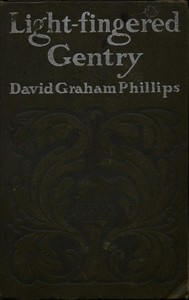
Light-Fingered Gentry — Themes and Context can be approached with a clearer sense of reading commitment from its source measurements: 127,723 words, 9 hr 16 min estimated reading time, and 17 detected text sections.
The text analysis averages about 14.9 words per sentence, while the detected sections provide another way to judge how the source is divided.
Project Gutenberg metadata also associates the work with “New York (N.Y.) -- Social life and customs -- Fiction,” connecting these edition facts with the source record’s subject description.
Explore this collection
These alternatives are selected using recorded categories and estimated reading time.
About 539 minutes
England London Nineteenth Century Fiction
123,906 recorded words. 17 minutes difference from this book's estimate.
View Gutenberg source #55326About 583 minutes
England London Nineteenth Century Fiction
133,976 recorded words. 27 minutes difference from this book's estimate.
View Gutenberg source #47640About 521 minutes
England London Nineteenth Century Fiction
119,748 recorded words. 35 minutes difference from this book's estimate.
View Gutenberg source #52729Search stored excerpts and compare books → Choose by your preferences →
Choices use stored catalog measurements. Estimates vary with reading speed. A shared category is a catalog label, not a claim that two books have the same argument or literary quality.
Search reads excerpt text stored with this catalog and links to its associated Gutenberg record. The connection is stored in the site database; this tool does not recheck that every excerpt is word-for-word identical to that external record. Excerpt search does not cover every chapter and does not verify historical publication dates.
Catalog snapshot checked: 2026-09-25. Coverage: 94 public books, 94 available source excerpts.
Read the complete public-domain text at its original source.
Read on Project GutenbergThe novel begins with a young woman leaving the main walk through deserted college grounds at Battle Field, entering a path down Pine Point, a fingerlike peninsula jutting into Otter Lake. The description emphasizes her somber dress and expression, her long, slim figure, and her hair severely plaited. She seems to diffuse a chill, like a precious stone. This opening establishes a mood of stillness and introspection, with the natural setting—white pines, primeval and odorous, and the lake's burnished reach—mirroring her isolation.
Later excerpts shift to a dialogue where a man insists on his marital rights, while the woman calmly repudiates the marriage, stating she has no sense of being married. Their exchange reveals a clash over the meaning of marriage, career, and heart, with the man admitting he could engage in financial 'graft' but hesitating to claim he is different. The excerpts suggest a narrative focused on psychological conflict and social critique.
The opening excerpt introduces a young woman whose appearance and demeanor are described in detail: somber, ascetic, shy, with a long, slim face and figure. She walks through a pine thicket on a stifling July day, the lake still and the clouds motionless. The prose is precise, noting the 'faint tracing' of the path and the 'murmurously musical' coolness among the pines. This setting establishes a contrast between the oppressive heat and the cool interior, perhaps reflecting the character's inner state.
In a later excerpt, a man confronts her, claiming she has no right to 'hang about another man's wife.' She responds tranquilly, asserting she has no sense of being married. He argues that their dead child should be a tie, but she dismisses the physical side of marriage, saying she tries to 'improve on nature.' This dialogue reveals a central tension: the man's possessive, natural view versus the woman's intellectual, self-respecting stance. The excerpts do not reveal the outcome of this conflict, but the sharpness of the exchange suggests a sustained exploration of gender roles and personal autonomy.
The man accuses the woman of having hidden herself from him during their marriage, and he admits he threw away 'the best there was in my life' for his career. She retorts, 'You aren't a human being. You are a career.' This line crystallizes a theme: the tension between professional ambition and emotional connection. The man later asks her to marry him again, proposing a 'joint, equal partner in our career,' but she refuses, saying she cannot interest herself in getting rich or distributing riches among sycophants.
When she mentions his business is 'about the best graft,' he hesitates, not denying he could take money but uncomfortable with her belief in his honesty. This moment hints at moral compromise in the financial world. The excerpts do not specify his business, but the catalog subjects—commercial crimes, capitalists and financiers—suggest a critique of corporate ethics. The woman's preference for 'a nobody with a heart' over a successful man without one frames a central moral choice.
Phillips's prose is notable for its psychological precision and social commentary. The woman's description as 'diffus[ing] a chill, like the feel of a precious stone' uses simile to convey emotional distance. The man's language is more direct and possessive: 'I'm jealous of all men.' Their dialogue is layered with irony, as when she mocks 'You men! You men, with your coarse, narrow ideas of us women.'
The excerpts also use setting to reinforce mood. The opening's 'snowy islets of summer cloud hung motionless, like frescoes in an azure ceiling' creates a static, almost painterly quality. Later, the man's confession that he 'walk[s] the floor and grind[s] my teeth in fury' when thinking of her with other men shifts to raw emotion. This contrast between controlled description and eruptive feeling suggests a narrative that oscillates between social critique and personal drama.
For a first reading, the opening excerpt establishes a strong sense of place and character. The detailed physical description of the woman—her long neck, slim hands, severely bound hair—invites attention to how appearance signals inner life. The dialogue that follows introduces a conflict without resolution, leaving the reader curious about the characters' past and future.
The excerpts also hint at broader social themes: the critique of marriage as an institution, the tension between personal integrity and financial success, and the role of women in a patriarchal society. The man's admission about 'graft' and the woman's rejection of wealth suggest a moral dimension. Readers should note the precise language and the way Phillips uses conversation to reveal character. The novel's length (over 127,000 words) indicates a slow, detailed exploration of these conflicts.
The excerpts from Light-Fingered Gentry offer a focused entry into a novel that balances psychological realism with social satire. Readers attentive to the opening's sensory details and the dialogue's sharp exchanges will find a narrative that rewards close reading. The tension between the woman's self-possession and the man's possessive desire, set against a backdrop of financial ethics, suggests a story that interrogates both personal and public morality. Approach the text with an eye for how Phillips uses setting and speech to dramatize inner conflict.
That rainy afternoon, I kept returning to the opening of Light-Fingered Gentry, the woman’s quiet walk, the weight of her choices. It made me think how personal integrity gets bent without anyone noticing. Later, half-dreaming, I stumbled onto The Vanishing of Tera — Background and Themes, and felt the same hush—like watching someone disappear into their own life.
Answer a few questions and save a private reflection on this device.