About 342 minutes
Clever Betsy: A Novel — A Reader’s Guide
England London Nineteenth Century Fiction
78,448 recorded words. 3 minutes difference from this book's estimate.
View Gutenberg source #52908
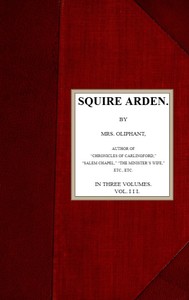
For Squire Arden; volume 3 of 3 — Inside the Classic, the stored edition analysis reports 77,913 words, 5 hr 39 min estimated reading time, and 7 detected text sections.
The text analysis averages about 16.3 words per sentence, while the detected sections provide another way to judge how the source is divided.
Project Gutenberg metadata also associates the work with “Inheritance and succession -- Fiction,” connecting these edition facts with the source record’s subject description.
Explore this collection
These alternatives are selected using recorded categories and estimated reading time.
About 342 minutes
England London Nineteenth Century Fiction
78,448 recorded words. 3 minutes difference from this book's estimate.
View Gutenberg source #52908About 345 minutes
England London Nineteenth Century Fiction
79,141 recorded words. 6 minutes difference from this book's estimate.
View Gutenberg source #54122About 332 minutes
England London Nineteenth Century Fiction
76,173 recorded words. 7 minutes difference from this book's estimate.
View Gutenberg source #48396Search stored excerpts and compare books → Choose by your preferences →
Choices use stored catalog measurements. Estimates vary with reading speed. A shared category is a catalog label, not a claim that two books have the same argument or literary quality.
Search reads excerpt text stored with this catalog and links to its associated Gutenberg record. The connection is stored in the site database; this tool does not recheck that every excerpt is word-for-word identical to that external record. Excerpt search does not cover every chapter and does not verify historical publication dates.
Catalog snapshot checked: 2026-09-25. Coverage: 94 public books, 94 available source excerpts.
Read the complete public-domain text at its original source.
Read on Project GutenbergThe third volume of Squire Arden opens with a charged domestic confrontation that immediately signals a shift in power. Arthur Arden enters the Pimpernel house asking after Miss Pimpernel, only to be met with Mrs. Pimpernel's fury, her words described as bearing down “like a conquering ship or a charge of cavalry.” The scene establishes a pattern of verbal combat and moral accusation that recurs throughout the volume. Oliphant’s prose here is notably physical: anger is registered in crimson faces, nervous trembles, and the sense of a fray already underway. The dialogue is rapid and cutting, with characters interrupting and overriding each other, reflecting the broader struggle over truth and reputation that drives the narrative.
The volume relies heavily on face-to-face confrontations to advance its plot and reveal character. The opening exchange between Arthur and Mrs. Pimpernel is a model: she accuses him of deserting her daughter, he deflects, and the scene escalates into a battle of epithets (“designing girl,” “artful little cheat”). These encounters are not merely expository; they are the primary means by which Oliphant dramatizes the moral and social stakes. Later, Edgar’s conversation with Mr. Fielding is similarly pitched, with the rector pressing Edgar to explain his strange behavior, and Edgar oscillating between lucidity and a kind of bitter, self-aware irony. The structure of these scenes—rapid-fire dialogue, physical descriptions of posture and movement, and a sense of imminent rupture—gives the volume a theatrical, almost claustrophobic intensity.
Two images recur with particular force: falls and traps. The volume opens with the aftermath of Miss Pimpernel’s fall from a phaeton, an event that sets the plot in motion. Edgar later describes his own “fall” from the position of squire, and the language of falling—physical, social, moral—permeates his speech. He speaks of the old squire’s letters as a “trap,” and wonders if they were left deliberately to ensnare him into complicity. The image of a trap is extended when Edgar says he “can’t help thinking he carried his enmity further than that,” suggesting a deliberate design to ruin him. These images are not merely decorative; they structure Edgar’s understanding of his situation as one of inevitable descent and entrapment, a world where agency is limited and the past exerts a deterministic pull.
Oliphant moves the narrative between domestic interiors—the Pimpernel house, the rectory, the Hall—and the interior landscape of Edgar’s mind. The domestic scenes are sharply observed, with attention to staircases, doorways, and the physical positioning of characters (Mrs. Pimpernel “came downstairs upon him,” Edgar and Mr. Fielding walk arm in arm). These spaces are charged with social meaning: the Pimpernel house is a site of accusation, the rectory a place of confession. But the most significant movement is psychological. Edgar’s speech to Mr. Fielding shifts from denial to confession to a kind of detached analysis of his own state. He describes his discovery as happening “on Sunday night—a hundred years ago,” collapsing time and emphasizing trauma. The movement between external action and internal revelation gives the volume its emotional weight, as the reader is drawn into Edgar’s fractured consciousness.
Edgar’s crisis is fundamentally one of identity, and Oliphant uses the language of inheritance to explore it. He is no longer “Squire Arden,” and the loss of that title is a loss of self. He speaks of Clare as “my sister” but immediately questions his right to call her that. He refers to “my table for the last time,” marking the end of his domestic authority. The legal language of entail, papers, and nullity recurs, but it is always inflected with personal anguish. Edgar’s question—“Is it not odd that Arthur Arden should be here at such a moment?”—points to the uncanny way inheritance and identity are bound up with chance and design. The volume’s language thus weaves together the technical and the emotional, showing how a change in legal status can unravel a person’s entire world.
Readers attentive to Oliphant’s use of physical detail will find the volume’s emotional logic embedded in its gestures and settings. The movement between houses and minds, the repeated images of falling and entrapment, and the charged dialogue all work together to create a portrait of a man losing his place in the world. The volume does not resolve Edgar’s fate, but it does offer a sustained exploration of how identity is bound up with property, name, and the stories we tell about ourselves.
There’s a particular ache in watching Edgar Arden trip over threads he can’t see, losing footing in rooms that once felt like home. It reminded me, strangely, of the quieter unease in According to Plato — Background and Themes, where ideas themselves become traps. I finished both feeling I’d walked a familiar corridor in the dark, only to find the walls had moved.
Save your reaction, strongest insight, and memorable passage.