About 347 minutes
God's Playthings — Edition Insights
England London Nineteenth Century Fiction
79,757 recorded words. 2 minutes difference from this book's estimate.
View Gutenberg source #49504
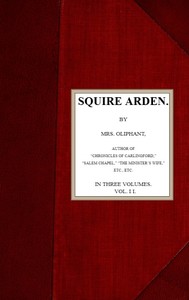
The source record for Squire Arden; volume 2 of 3 — Edition Insights measures this digital text at 79,141 words, 5 hr 45 min estimated reading time, and 7 detected text sections.
The text analysis averages about 18.0 words per sentence, while the detected sections provide another way to judge how the source is divided.
Project Gutenberg metadata also associates the work with “Inheritance and succession -- Fiction,” connecting these edition facts with the source record’s subject description.
Explore this collection
These alternatives are selected using recorded categories and estimated reading time.
About 347 minutes
England London Nineteenth Century Fiction
79,757 recorded words. 2 minutes difference from this book's estimate.
View Gutenberg source #49504About 342 minutes
England London Nineteenth Century Fiction
78,448 recorded words. 3 minutes difference from this book's estimate.
View Gutenberg source #52908About 339 minutes
England London Nineteenth Century Fiction
77,913 recorded words. 6 minutes difference from this book's estimate.
View Gutenberg source #54186Search stored excerpts and compare books → Choose by your preferences →
Choices use stored catalog measurements. Estimates vary with reading speed. A shared category is a catalog label, not a claim that two books have the same argument or literary quality.
Search reads excerpt text stored with this catalog and links to its associated Gutenberg record. The connection is stored in the site database; this tool does not recheck that every excerpt is word-for-word identical to that external record. Excerpt search does not cover every chapter and does not verify historical publication dates.
Catalog snapshot checked: 2026-09-25. Coverage: 94 public books, 94 available source excerpts.
Read the complete public-domain text at its original source.
Read on Project GutenbergMrs. Oliphant opens this volume by reversing the sibling dynamic: where Clare once fretted over Edgar, now Edgar is consumed by anxiety for her. The narrator notes that Edgar 'felt but lightly the slights or the censures of fortune' but that this easy mind 'forsook him completely when his own duties were in question.' The prose tightens around his internal debate—whether to remonstrate, wait, or interfere in Clare's possible attachment to their cousin Arthur. This shift in perspective gives the volume a more introspective, hesitant rhythm, as Edgar's foreign-bred theories clash with English propriety.
The opening chapter establishes a new narrative pace: slower, more recursive, circling Edgar's thoughts. Oliphant uses free indirect style to render his confusion: 'Should he acquiesce simply without a word? Should he remonstrate?' The repetition of 'should' mimics his stalled decision-making. Unlike Clare's earlier sharp judgments, Edgar's voice is tentative, full of qualifiers. The narrator observes that 'he had all the theories of a young man against any restraint or contradiction of the affections; but held them much more strongly than most young men'—a wry comment on his self-awareness. This section contrasts his foreign upbringing with English habits, a detail that colours his every move. The prose lingers on his sense of incapacity, making the reader feel the weight of his responsibility.
When Mr. Perfitt arrives to report Arthur's attentions to 'little Jeanie Murray,' the narrative switches to Clare's perspective. Her voice becomes 'distinct chill tones,' and the narrator describes her as 'frozen suddenly where she sat—frozen to her very heart.' The repetition of 'frozen' underscores a violent emotional clampdown. Oliphant renders her reply—'I will take care that it does not occur again'—as a physical force: 'it went like a touch of ice through Perfitt's bones.' The scene is a masterclass in controlled fury. Clare's dignity is a mask; the narrator notes she was 'a little flushed, but showing no other traces of that sudden tumult.' The pace here is clipped, dialogue-driven, with Perfitt's stammering and hat-crushing providing a comic counterpoint to Clare's glacial precision.
After leaving Arden, Perfitt's internal monologue shifts the tone again. He slaps his thigh 'with supreme self-contempt,' muttering, 'My man, you’ve gone and put your foot in it now.' Oliphant gives him a distinct Scots-inflected voice ('Dash ye! and dash him, the ne’er-do-weel!'), which lightens the atmosphere after Clare's icy scene. His worry that he has 'bothered that poor lassie' introduces a note of rueful sympathy. The narrative then pulls back to Clare's reaction: 'absolutely stunned by the blow which had just fallen upon her.' The chapter ends with her feeling 'the first great slight she had ever received,' a phrase that hints at deeper wounds to come. This section balances the earlier tension with a more colloquial, self-deprecating voice, varying the novel's emotional register.
Readers attentive to voice will notice how Oliphant modulates between Edgar's hesitant introspection, Clare's brittle formality, and Perfitt's earthy Scots. These shifts in register do more than vary pace—they map the social and emotional distances between characters. The volume's middle position, between Arden's introduction and its conclusion, allows these contrasts to sharpen without resolution, making the reader alert to every change in tone.
There’s something about Edgar’s fretful watch over Clare—that ache of wanting to protect someone who won’t let you near—that reminded me of the quiet corridors in The White Room — Text and Context. Both feel like waiting rooms for feelings too heavy to name aloud. I closed the volume and just sat with that heaviness for a while.
Save your reaction, strongest insight, and memorable passage.