About 467 minutes
Tales of two people — A Reader’s Guide
England London Nineteenth Century Fiction
107,279 recorded words. 16 minutes difference from this book's estimate.
View Gutenberg source #49630
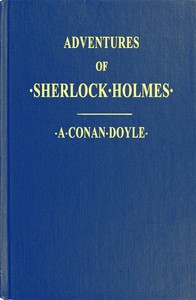
The source record for Adventures of Sherlock Holmes Illustrated — Background and Themes measures this digital text at 111,081 words, 8 hr 3 min estimated reading time, and 12 detected text sections.
The text analysis averages about 15.8 words per sentence, while the detected sections provide another way to judge how the source is divided.
Project Gutenberg metadata also associates the work with “Holmes, Sherlock (Fictitious character) -- Fiction,” connecting these edition facts with the source record’s subject description.
Explore this collection
These alternatives are selected using recorded categories and estimated reading time.
About 467 minutes
England London Nineteenth Century Fiction
107,279 recorded words. 16 minutes difference from this book's estimate.
View Gutenberg source #49630About 466 minutes
England London Nineteenth Century Fiction
107,059 recorded words. 17 minutes difference from this book's estimate.
View Gutenberg source #49342About 505 minutes
England London Nineteenth Century Fiction
115,984 recorded words. 22 minutes difference from this book's estimate.
View Gutenberg source #47319Search stored excerpts and compare books → Choose by your preferences →
Choices use stored catalog measurements. Estimates vary with reading speed. A shared category is a catalog label, not a claim that two books have the same argument or literary quality.
Search reads excerpt text stored with this catalog and links to its associated Gutenberg record. The connection is stored in the site database; this tool does not recheck that every excerpt is word-for-word identical to that external record. Excerpt search does not cover every chapter and does not verify historical publication dates.
Catalog snapshot checked: 2026-09-25. Coverage: 94 public books, 94 available source excerpts.
Read the complete public-domain text at its original source.
Read on Project GutenbergThe opening of Adventures of Sherlock Holmes immediately establishes a paradox: Holmes is introduced as “the most perfect reasoning and observing machine,” yet the first story revolves around Irene Adler, “the woman” who alone commands his respect. This tension between emotional detachment and fascination runs through the collection. The excerpts show Doyle’s method of grounding Holmes’s deductions in concrete, often mundane objects—a hat, a goose, a bird’s crop—while the detective’s voice remains coolly analytical. Watson’s narration, meanwhile, supplies warmth and occasional bafflement, creating a steady counterpoint to Holmes’s precision.
In “A Scandal in Bohemia,” Watson describes Holmes as a man who views emotions as “grit in a sensitive instrument.” Yet the story’s central figure is Irene Adler, whose intelligence and resourcefulness earn Holmes’s lasting admiration. The narrator notes that Holmes “never spoke of the softer passions, save with a gibe and a sneer,” but Adler’s photograph becomes a prized possession. This contradiction—a reasoning machine who keeps a memento of the one person who outwitted him—sets a pattern for the collection. Later stories rarely revisit this emotional undercurrent, but its presence in the opening tale colors the reader’s perception of Holmes’s character.
Doyle frequently builds mysteries around ordinary items. In “The Blue Carbuncle,” a goose and a hat become the focus of Holmes’s investigation. He examines the hat’s condition to deduce its owner’s habits: “a touch of red in nose and cheeks, with a slight tremor of his extended hand, recalled Holmes’s surmise as to his habits.” The goose’s crop yields the stolen gem. Similarly, in “The Red-Headed League,” a pawnbroker’s shop and a copied advertisement form the puzzle. These details ground the stories in a recognizable London, where the fantastic emerges from the everyday. Holmes’s method—treating each object as a text to be read—makes the reader an active observer.
Dr. John Watson serves as both participant and chronicler. His narration provides a human counterweight to Holmes’s detachment. In the excerpts, Watson notes his own “marriage had drifted us away from each other,” and he often arrives after Holmes has begun working. He records Holmes’s deductions without fully understanding them, as when Holmes remarks on a woodcock’s crop. Watson’s presence allows Doyle to explain clues without breaking the story’s pace. The doctor’s occasional bafflement—and his willingness to learn—mirrors the reader’s experience. His voice is consistent: observant, slightly formal, and always loyal, making him an ideal guide through these twelve adventures.
Readers approaching these stories for the first time may find it useful to track how Doyle introduces each case: often through a client’s visit to 221B Baker Street, followed by Holmes’s rapid-fire observations. The illustrations mentioned in the front matter—such as “The gentleman in the pew handed it up to her”—hint at visual storytelling that complements the text. Pay attention to the small details Watson records; they are rarely accidental.
I remember winter evenings when the blue carbuncle’s goose felt less like a riddle and more like a hearth—proof that even cold reason warms itself on homely things. Rejected of Men stirred that same ache later, its quiet dignity under judgment echoing Holmes’s own lonely clarity. Some stories read like a hand on the shoulder, not a mystery to solve. Rejected of Men: A Story of To-day — Reading Companion stayed with me that way.
Save your reaction, strongest insight, and memorable passage.