1

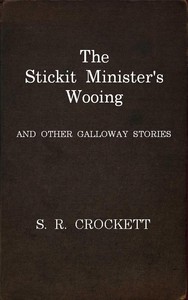
The Stickit Minister's Wooing, and Other Galloway Stories — Story, Setting & Ideas
(0 User reviews)
629
Project Gutenberg
2015
Not confirmed
Short stories; Humorous stories; Country life -- Fiction; Scotland -- Social life and customs -- 19th century -- Fiction
Readers of public-domain and historical texts
Project Gutenberg digital edition
en
Edition facts
Words
107,059
Reading time
466 min
Text sections
15
This digital edition of The Stickit Minister's Wooing, and Other Galloway Stories — Story, Setting & Ideas is described by source-level measurements including 107,059 words, 7 hr 46 min estimated reading time, and 15 detected text sections.
The text analysis averages about 18.2 words per sentence, while the detected sections provide another way to judge how the source is divided.
Project Gutenberg metadata also associates the work with “Short stories,” connecting these edition facts with the source record’s subject description.
Source:
Project Gutenberg record #49342
S. R. Crockett's collection of Galloway stories, centered on the 'Stickit Minister' and rural Scottish life, uses recurring imagery of domestic chaos and swift, decisive female characters to structure its narratives.
Read the complete public-domain text at its original source.
Read on Project GutenbergThe collection opens with a dedication to R. L. S., recalling how Crockett's earlier 'Stickit Minister' stories found encouragement from Stevenson in Samoa and a London journalist. This second series continues the focus on Galloway's rural folk, with a narrative voice that moves between wry observation and affectionate detail. The stories often hinge on a moment of domestic upheaval—a farm thrown into disorder, a household lacking a capable hand—before a strong-willed woman steps in to restore order, as seen in the excerpt where the Hempie arrives at Nether Neuk.
Recurring Images of Domestic Disarray
The excerpts repeatedly depict farms and homes in states of neglect: pots and pans lie unwashed, byres become impassable, and ploughmen idle away mornings. This disorder is not merely background but a structural cue that a central character—often a woman—will intervene. At Nether Neuk, the Hempie finds 'every individual pot and pan in the house cumbered the back kitchen unwashed and begrimed.' The herds sleep behind dyke-backs while lambs stray. Such scenes establish a baseline of chaos that the narrative then resolves through decisive action, a pattern that likely recurs across the collection.
The Hempie's Swift, Physical Authority
Elizabeth Chrystie, called the Hempie, embodies a recurring type: a woman who acts with immediate, physical competence. She swings her box onto a grocer's barrow, commands the boy, and catches her train without relying on the delayed gig. Her movements are described with precision—'deft strong movement,' 'straightened her tall lithe figure'—and her speech is curt and commanding: 'Take that to the station, boy.' This contrasts with the male narrator's more passive role, as he watches from the window while Nance nestles against his coat. The Hempie's authority is established through action, not dialogue alone.
Movement Between Interior and Exterior Scenes
The narrative shifts fluidly between enclosed domestic spaces and the open Galloway landscape. The opening excerpt moves from the farmhouse kitchen to the byres and hill pastures, then to the station and the road. The Hempie's departure is tracked through the 'little oriel window,' with the narrator and Nance observing from inside. This toggling between interior observation and exterior action structures the storytelling: characters are often seen entering or leaving houses, crossing thresholds, or being watched from windows. The dedication itself evokes a transoceanic movement, from Scotland to Samoa and back.
Voice and the Use of Scots Dialect
Crockett's prose mixes standard English with Scots dialect, often within the same sentence. The boy's reply—'A' richt, mem!'—sits alongside the narrator's more formal 'I reproved her.' This code-switching marks social boundaries: the narrator uses Scots for quoted speech but standard English for narration. The Hempie's own speech is largely standard, but her commands are terse. The dialect is not ornamental; it signals class, region, and immediacy. The dedication's reference to 'that grey Galloway land' sets a regional tone that the stories sustain through such linguistic texture.
Readers will find that the collection rewards attention to how Crockett stages entrances and exits—characters arriving to restore order or departing with brisk independence. The stories are less about plot twists than about the rhythm of disruption and recovery, often embodied by a single resolute figure. The excerpts suggest a world where domestic competence is a form of heroism, and where the landscape of Galloway is as much a character as the people who move through it.
I’ve often thought the Stickit Minister’s household, for all its clatter, shares a quiet pulse with the more measured rooms in Squire Arden; volume 3 of 3 — Inside the Classic—both hold women who tidy chaos with a glance, and both leave a warmth lingering long after the lamp is out.
There are no reviews for this eBook.
There are no comments for this eBook.
Reader reflection
Record your reading impressions
A brief reflection can help important ideas stay with you longer.
Your progress
0
/
10
2
How did the book work for you overall?
3
Would you pass this book on to a friend?
4
How much effort did this book require?
5
How distinctive were its ideas or approach?
6
How did the reading compare with what you expected?
7
Would you start a conversation about this book?
8
Could you follow the author’s main argument?
9
Which lesson or insight stayed with you?
10