1

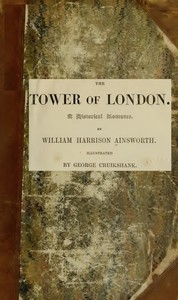
The Tower of London: A Historical Romance, Illustrated — Text and Context
(0 User reviews)
1921
Project Gutenberg
2015
Not confirmed
London (England) -- Fiction; Grey, Jane, Lady, 1537-1554 -- Fiction; Tower of London (London, England) -- Fiction
Readers of public-domain and historical texts
Project Gutenberg digital edition
en
Edition facts
Words
191,661
Reading time
834 min
Text sections
25
The Tower of London: A Historical Romance, Illustrated — Text and Context can be approached with a clearer sense of reading commitment from its source measurements: 191,661 words, 13 hr 54 min estimated reading time, and 25 detected text sections.
The text analysis averages about 19.0 words per sentence, while the detected sections provide another way to judge how the source is divided.
Project Gutenberg metadata also associates the work with “London (England) -- Fiction,” connecting these edition facts with the source record’s subject description.
Source:
Project Gutenberg record #49850
Ainsworth's 1840 historical romance combines detailed descriptions of the Tower of London's architecture and history with a melodramatic plot centered on Lady Jane Grey. The excerpts show a blend of Gothic atmosphere, comic interludes involving giants and a dwarf, and political intrigue, though the catalog subjects only partially reflect the work's actual content.
Read the complete public-domain text at its original source.
Read on Project GutenbergWilliam Harrison Ainsworth's The Tower of London: A Historical Romance (1840) opens not with a historical event but with a procession: Queen Jane enters the Tower in a manner that immediately establishes the novel's blend of pageantry and peril. The catalog subjects list London, Lady Jane Grey, and the Tower itself, but the excerpts reveal a work that is as much about grotesque comedy and architectural set-pieces as about political tragedy. George Cruikshank's illustrations, referenced in the title, are not present in the text excerpts, but the prose itself is highly visual, describing costumes, settings, and physical action in vivid detail.
Giants, Dwarfs, and the Grotesque
The excerpts introduce a cast of characters that would be out of place in a strictly historical novel: three giants named Og, Gog, and Magog; a dwarf named Xit; and a fool named Jane. In one scene, Xit, dressed as Cupid, emerges from a pasteboard monster's jaws, shoots arrows at Queen Mary, Princess Elizabeth, and others, and engages in a witty exchange with Jane the Fool. This comic interlude, complete with slapstick and wordplay, sits uneasily alongside the catalog's emphasis on historical figures like Lady Jane Grey. The novel's tone is deliberately mixed, mixing high drama with low comedy.
The Tower as a Character
Ainsworth devotes entire chapters to the Tower's history, architecture, and dungeons, as seen in Book the Second, Chapter IV: "Of the Tower of London; its antiquity and foundation; its magnitude and extent; its keep, palace, gardens, fortifications, dungeons, and chapels." This catalog-like description interrupts the narrative, suggesting that the building itself is a central character. The excerpts also mention specific locations—Saint John's Chapel, the By-Ward Tower, the Brick Tower, the Devilin Tower—that ground the action in a real, tangible space. The catalog subject "Tower of London (London, England) -- Fiction" is accurate, but the novel's treatment goes beyond setting to include extensive historical and architectural exposition.
Political Intrigue and Melodramatic Plotting
The chapter titles in the table of contents reveal a plot dense with conspiracy, imprisonment, and sudden reversals: "How the Duke of Northumberland menaced Simon Renard in Saint Peter's Chapel," "How the Council deposed Queen Jane; and how she fled from the Tower." The excerpts, however, offer little of this political action directly; instead, they focus on the comic scene with Xit and the formal procession. This discrepancy suggests that the novel's political drama may be conveyed through melodramatic confrontations and Gothic tropes rather than through nuanced historical analysis. The catalog subject "Grey, Jane, Lady, 1537-1554 -- Fiction" is present, but the excerpts show that her story is only one thread in a larger tapestry of Tower lore.
Readers approaching The Tower of London should expect a work that oscillates between historical exposition, Gothic horror, and broad comedy. The catalog subjects provide a starting point, but the novel's actual content is more varied and eccentric. Pay attention to how Ainsworth uses the Tower's physical spaces to structure his narrative, and note the frequent shifts in tone that characterize this Victorian historical romance.
Reading about the grey stones and doomed ladies of the Tower, I found my thoughts drifting somewhere gentler, to the odd, knotted threads of ordinary lives in Jaunty Jock, and Other Stories — Story, Setting & Ideas. Both hold that quiet ache of place, how a setting remembers what people forget. A strange pairing, perhaps, but the feeling lingered after the page turned.
There are no reviews for this eBook.
There are no comments for this eBook.
Reader reflection
Before you leave, reflect on the book
Use these questions to collect your thoughts before moving on.
Your progress
0
/
10
2
How much did you enjoy the reading experience?
3
How likely are you to recommend this book?
4
How demanding did the text feel?
5
Would you read this book again?
6
Did it raise ideas you would like to talk about?
7
Was the book easy to understand?
8
Did the book deliver what you hoped for?
9
In one sentence, what did you learn?
10