About 115 minutes
The Observations of Henry Illustrated — Themes and Context
England London Nineteenth Century Fiction
26,446 recorded words. 57 minutes difference from this book's estimate.
View Gutenberg source #47774
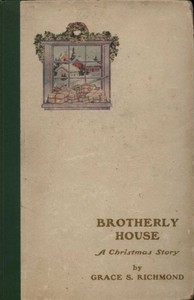
This digital edition of Brotherly House — Inside the Classic is described by source-level measurements including 13,152 words, 58 min estimated reading time, and 3 detected text sections.
The text analysis averages about 15.2 words per sentence, while the detected sections provide another way to judge how the source is divided.
Project Gutenberg metadata also associates the work with “Christmas stories,” connecting these edition facts with the source record’s subject description.
Explore this collection
These alternatives are selected using recorded categories and estimated reading time.
About 115 minutes
England London Nineteenth Century Fiction
26,446 recorded words. 57 minutes difference from this book's estimate.
View Gutenberg source #47774About 124 minutes
England London Nineteenth Century Fiction
28,483 recorded words. 66 minutes difference from this book's estimate.
View Gutenberg source #54103About 137 minutes
England London Nineteenth Century Fiction
31,395 recorded words. 79 minutes difference from this book's estimate.
View Gutenberg source #51928Search stored excerpts and compare books → Choose by your preferences →
Choices use stored catalog measurements. Estimates vary with reading speed. A shared category is a catalog label, not a claim that two books have the same argument or literary quality.
Search reads excerpt text stored with this catalog and links to its associated Gutenberg record. The connection is stored in the site database; this tool does not recheck that every excerpt is word-for-word identical to that external record. Excerpt search does not cover every chapter and does not verify historical publication dates.
Catalog snapshot checked: 2026-09-25. Coverage: 94 public books, 94 available source excerpts.
Read the complete public-domain text at its original source.
Read on Project GutenbergThe story opens with Stephen Kingsley, an invalid, reading a letter from his brother Samuel that bristles with phrases like "acted not only unfairly, but contemptibly" and "too deliberately, too designedly." Stephen's own voice, marked by mild irony—"he 'doesn't like to say it,' yet he seems to say it with considerable relish"—immediately establishes a contrast between his gentle, diplomatic nature and Samuel's vigorous indignation. The narrative voice, too, leans into understatement: Stephen considers the brothers' relations "er—lacking harmony." This careful diction, paired with the physical detail of Stephen lying "back among his invalid's pillows, with a wry little twist of pain about his gentle lips," grounds the reader in a specific, embodied point of view before any action unfolds.
Stephen's plan to host a Christmas house-party is presented not as spontaneous generosity but as a calculated intervention. He announces it to his housekeeper, Mrs. Griggs, with an air of deliberation: "I am thinking of having a Christmas house-party. Merely the family, you know." The phrase "merely the family" is ironic, given that the family includes at least three estranged brothers and a quarrel whose proportions are described as "far more serious" than a minor rift between two others. The narrative emphasizes Stephen's helplessness—he is an invalid—yet he issues orders to the capable, iron-gray Mrs. Griggs with surprising firmness. The house itself becomes a stage: the opening scene in Stephen's sickroom, the later window-watching, and the barn where cars are parked all suggest a contained space where conflicts must be confronted. The story's structure, moving from letter to plan to arrival, mirrors Stephen's methodical approach to reconciliation.
The brothers' estrangement is rendered through sharply contrasting speech. Samuel's letter uses forceful, absolute language: "I shall not overlook it. I shall——" The dash implies a threat left unfinished. Sylvester, by contrast, is initially heard only through Stephen's summary, but later his commands are terse and practical: "I'll look out where you back; let her go." The narrator describes Samuel's writing as "vigorous scrawls and equally vigorous language," while Stephen's own commentary is laced with mild irony. When two other brothers, William and George, watch from a window, their dialogue reveals a different kind of distance: George is partially deaf, and William must speak into his "interrogative best ear." This physical barrier mirrors the emotional gaps between siblings. Even the cars—Samuel's "slim, powerful machine" with an unmuffled exhaust "roaring a deep note of power" versus Sylvester's "big brown limousine" built for comfort—become emblems of temperament.
Midway through the excerpts, the narrative pivots from adult quarrels to a child's crisis. Harold, George's son, bursts into a room with "a pale, frightened face and a pair of very red eyes" and confesses to his father: "I—threw—Syl!" The boy's broken speech and physical collapse—"He buried his head against his father's arm"—introduce a new kind of tension, one that is immediate and visceral rather than simmering. Uncle William, stepping out from behind a curtain, whispers, "We all know it was an accident." This moment of quiet reassurance contrasts with the earlier heated language. The accident itself is not described; only its aftermath is shown, leaving the reader to infer the event from the characters' reactions. The shift to a child's perspective—and the sudden appearance of a nursemaid carrying "Mrs. Sam's baby, the prettiest baby of the three who were in the house"—redirects attention from abstract grievances to concrete, urgent needs.
The most dynamic passage in the excerpts is the car ride. Sylvester, despite the quarrel, helps Samuel prepare his car, handing him "the heavy motoring gloves of which Samuel had not stopped to think." Then Samuel "opened his throttle" and the machine "shot away down the road like the wind." The language of speed—"roaring," "shot," "like the wind"—creates a sense of release and urgency. Inside the house, William and George watch and comment. William notes that Sam's car is "extremely powerful" and that "Sam's pace going to meet the doctor would make Syl hang on some." George replies, "It's Sam's boy," acknowledging the stakes. The ride is not described from inside the car; instead, it is observed from the window, emphasizing the distance between the watchers and the participants. Yet the act of going together, after years of voluntary separation, is itself a form of reconciliation. The narrator understates: "Not a member of the family but would admit that."
Richmond's prose rewards attention to small gestures—a whispered word, a handed glove, a baby brought to an invalid's room. The story's brevity (13,152 words) means every detail carries weight. Readers may note how often characters are described watching or listening from thresholds: windows, curtains, doorways. These liminal spaces mirror the brothers' position between estrangement and reunion. The Christmas setting is present but understated, a backdrop rather than a driver of plot.
Reading Brotherly House, I kept thinking how quietly the brothers’ sharp words filled the room, each one trying to hide behind a joke. That same ache of missed connection lives inside A Prince of Swindlers — Key Ideas to Explore, where charm becomes a kind of armor. It stayed with me, the way a cold house does after you finally warm it.
Your answers remain private and are stored only in this browser.