About 162 minutes
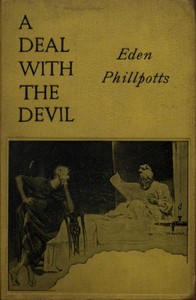
A Deal with the Devil — A Reader’s Guide
England London Nineteenth Century Fiction
37,175 recorded words. 9 minutes difference from this book's estimate.
View Gutenberg source #47246
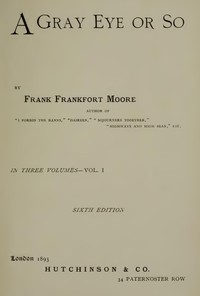
Before opening A Gray Eye or So. In Three Volumes—Volume I — Context and Discussion, the edition data offers a quick orientation: 39,255 words, 2 hr 51 min estimated reading time, and 6 detected text sections.
The text analysis averages about 18.5 words per sentence, while the detected sections provide another way to judge how the source is divided.
Project Gutenberg metadata also associates the work with “Mate selection -- Fiction,” connecting these edition facts with the source record’s subject description.
Explore this collection
These alternatives are selected using recorded categories and estimated reading time.
About 162 minutes
England London Nineteenth Century Fiction
37,175 recorded words. 9 minutes difference from this book's estimate.
View Gutenberg source #47246About 154 minutes
England London Nineteenth Century Fiction
35,224 recorded words. 17 minutes difference from this book's estimate.
View Gutenberg source #48473About 204 minutes
England London Nineteenth Century Fiction
46,864 recorded words. 33 minutes difference from this book's estimate.
View Gutenberg source #47061Search stored excerpts and compare books → Choose by your preferences →
Choices use stored catalog measurements. Estimates vary with reading speed. A shared category is a catalog label, not a claim that two books have the same argument or literary quality.
Search reads excerpt text stored with this catalog and links to its associated Gutenberg record. The connection is stored in the site database; this tool does not recheck that every excerpt is word-for-word identical to that external record. Excerpt search does not cover every chapter and does not verify historical publication dates.
Catalog snapshot checked: 2026-09-25. Coverage: 94 public books, 94 available source excerpts.
Read the complete public-domain text at its original source.
Read on Project GutenbergThe novel begins not with a heroine but with a dispute over abstraction: Harold claims to be talking about 'woman in the abstract,' while Edmund retorts that no such thing exists—only the woman one loves or the woman who refuses to love. A third man, Brian, interjects with a story about Larry O'Leary, grounding the philosophical exchange in Irish local color. The setting is a boat on a lough, and the chapter titles—'On Certain Abstractions,' 'On a Great Hope,' 'On Honesty and the Working Man'—announce a pattern of essayistic headings that promise more talk than action.
The opening dialogue establishes a rhythm of epigram and counter-epigram. Edmund's definition of cynical talk about women is immediately tested by Harold: 'Does that mean that you have been unloved by many?' The exchange is interrupted by Brian's digressions, which are not mere comic relief but a competing mode of storytelling—anecdotal, local, and sly. The chapter titles themselves read like lecture topics, yet the actual content is playful and self-aware. The men's conversation is the primary event; physical action (rowing, drifting) is minimal and often pretended. This suggests a novel more interested in how people talk about courtship than in courtship itself.
Life at the Castle, we are told, 'involved a good deal of drifting.' Guests drift out after breakfast, drift back to lunch, and drift until dinner. The phrase recurs, turning aimless social movement into a structural principle. Lady Innisfail and Miss Craven discuss Harold's intentions with the delicacy of those who have been 'filtering' a French novel—a metaphor that hints at how the characters themselves are filtered through conversation and indirect observation. The plot advances not through dramatic scenes but through reported letters, overheard remarks, and the comings and goings of servants like Brian, who delivers a note from Mr. Wynne explaining his absence. The castle is a space where intentions are inferred, not declared.
The title 'A Gray Eye or So' appears nowhere in the excerpts, yet the phrase suggests a casual, almost dismissive attention to a physical detail. The catalog subjects—mate selection, courtship, political fiction—are only partially borne out by the text. The political element is absent from these pages; instead, the novel dwells on social maneuvering and verbal sparring. The 'gray eye' may belong to Helen Craven, who is described only by her brow and her role as a filter of French fiction. The novel's interest lies less in romantic outcomes than in the process of observation and misinterpretation. Readers should expect a comedy of manners that values wit over plot.
This first volume sets up a world where talk is the primary currency and action is deferred. Readers who enjoy the banter of the opening will find the novel's pleasures in its dialogue and its ironic commentary on social rituals. The Irish setting and the character of Brian add a layer of local color that complicates the English country-house conventions. Approach the book as a conversation rather than a courtship plot.
There’s a certain patience in A Gray Eye or So, those long afternoons of talk where intentions hide behind wit. It reminds me of the quieter deceptions in Mr. Incoul's Misadventure — Context and Discussion, where a gentleman’s own steadiness becomes his undoing. Both seem to trust that a slow glance reveals more than a hurried stare. A small, shared temperament, I’d call it.
Save your reaction, strongest insight, and memorable passage.