About 430 minutes
Black is White — Key Ideas to Explore
Time Travel Speculative Futures
98,731 recorded words. 35 minutes difference from this book's estimate.
View Gutenberg source #54097
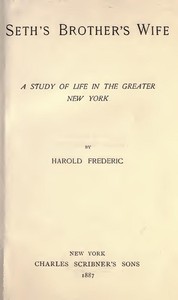
The catalog record for Seth's Brother's Wife: A Study of Life in the Greater New York — Edition Insights provides practical reading context through 106,869 words, 7 hr 45 min estimated reading time, and 12 detected text sections.
The text analysis averages about 19.1 words per sentence, while the detected sections provide another way to judge how the source is divided.
Project Gutenberg metadata also associates the work with “Villages -- Fiction,” connecting these edition facts with the source record’s subject description.
Explore this collection
These alternatives are selected using recorded categories and estimated reading time.
About 430 minutes
Time Travel Speculative Futures
98,731 recorded words. 35 minutes difference from this book's estimate.
View Gutenberg source #54097About 506 minutes
Time Travel Speculative Futures
116,265 recorded words. 41 minutes difference from this book's estimate.
View Gutenberg source #46462About 416 minutes
Time Travel Speculative Futures
95,549 recorded words. 49 minutes difference from this book's estimate.
View Gutenberg source #48937Search stored excerpts and compare books → Choose by your preferences →
Choices use stored catalog measurements. Estimates vary with reading speed. A shared category is a catalog label, not a claim that two books have the same argument or literary quality.
Search reads excerpt text stored with this catalog and links to its associated Gutenberg record. The connection is stored in the site database; this tool does not recheck that every excerpt is word-for-word identical to that external record. Excerpt search does not cover every chapter and does not verify historical publication dates.
Catalog snapshot checked: 2026-09-25. Coverage: 94 public books, 94 available source excerpts.
Read the complete public-domain text at its original source.
Read on Project GutenbergHarold Frederic opens Seth's Brother's Wife with a quarrel overheard in a farmhouse kitchen, rendered in thick upstate New York dialect: “Ef ther’ ain’t a flare-up in this haouse ’fore long, I miss my guess.” The hired girl Alvira and the farmhand Milton Squires speak in a vernacular that immediately establishes class and region, while the narrator’s own voice—precise, slightly ironic—describes the “ricketty and ancient” barns and the “black mire of the barnyard.” This double register, alternating between colloquial speech and a more literary descriptive mode, sets up the novel’s central tension between rural stasis and the wider world.
Frederic renders the speech of his farm characters with unusual fidelity. Alvira’s “I knaow, Milton” and her complaint that Sabrina might “wait at least till th’ corpse was aout o’ th’ haouse” are not merely decorative; they signal a social hierarchy in which the hired help comment on the family’s affairs from a position of powerless intimacy. The narrator, by contrast, uses a standard literary English that can anatomize a scene with detachment: the sunlight “would have helped to glorify any human being less hopelessly commonplace than Milton Squires.” This juxtaposition creates a layered effect—the reader hears the characters’ raw opinions while being guided by a more analytical eye. The dialect is never mocked, but it is carefully framed, reminding us that the story is being told from a vantage point outside the kitchen door.
The novel’s rhythm changes markedly when Seth returns to the farm. Early chapters move slowly, filled with description of barns, cows, and the “perfect silence” of the landscape. But when Seth sees Isabel approaching, the prose accelerates: “She was walking forth swiftly to meet him—coming over the grass with a gliding haste which had a wealth of welcome in every motion.” Sentences grow shorter, punctuated by dashes and exclamations. The narrator’s earlier detachment gives way to Seth’s heightened perception: Isabel’s dress becomes “the shadow on golden grain, or the light on dark puce grapes.” This shift from a static, almost ethnographic gaze to a breathless, subjective rush mirrors Seth’s own emotional awakening and signals a change in the novel’s concerns—from the farm’s routines to the complications of desire and ambition.
Frederic, himself a journalist, often writes as if composing a dispatch from an unfamiliar country. The farm is described with the precision of a reporter noting details: “the three great barns, standing in the shadow to the south, were ricketty and ancient without being comely”; the cows are “standing idly fetlock-deep in the black mire.” This observational style gives the setting a documentary weight. Yet the same eye can turn lyrical, as when Seth sees the farm in Indian summer: “the cluster of bright, neat buildings fell into picturesque lines of composition before him.” The narrator moves between fact-gathering and aesthetic appreciation, a duality that reflects Seth’s own divided loyalties—between the farm he left and the city where he works as a journalist. The novel’s pacing, alternating between patient catalog and sudden emotional intensity, may be read as a formal expression of that conflict.
Readers will notice how Frederic uses the landscape itself as a kind of clock: the long, still descriptions of farm life measure out the days, while the quicker, more fragmented scenes in New York or during political conventions mark a different tempo. Pay attention to who is speaking and in what register—the novel’s meaning often lies in the gap between what characters say in dialect and what the narrator tells us in standard English. This is not a book that hurries, but its patience is strategic.
Reading Seth’s Brother’s Wife, I kept noticing how the quiet ache of unspoken faith lingers between the farmhouse walls, much as it does in The Gates Ajar — Background and Themes. Both feel like old photographs—faces stiff with hope, rooms heavy with longing. Frederic’s pacing left me turning pages slowly, remembering my grandmother’s parlor and its hushed certainties.
Save your reaction, strongest insight, and memorable passage.