About 104 minutes
When Sarah Saved the Day — Background and Themes
Time Travel Speculative Futures
23,910 recorded words. 29 minutes difference from this book's estimate.
View Gutenberg source #52257
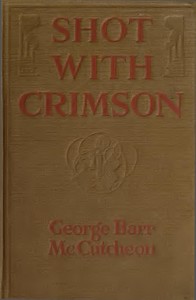
Shot With Crimson — A Reader’s Guide can be approached with a clearer sense of reading commitment from its source measurements: 30,482 words, 2 hr 13 min estimated reading time, and 4 detected text sections.
The text analysis averages about 13.3 words per sentence, while the detected sections provide another way to judge how the source is divided.
Project Gutenberg metadata also associates the work with “New York (N.Y.) -- Fiction,” connecting these edition facts with the source record’s subject description.
Explore this collection
These alternatives are selected using recorded categories and estimated reading time.
About 104 minutes
Time Travel Speculative Futures
23,910 recorded words. 29 minutes difference from this book's estimate.
View Gutenberg source #52257About 171 minutes
Time Travel Speculative Futures
39,138 recorded words. 38 minutes difference from this book's estimate.
View Gutenberg source #47702About 185 minutes
Time Travel Speculative Futures
42,462 recorded words. 52 minutes difference from this book's estimate.
View Gutenberg source #51557Search stored excerpts and compare books → Choose by your preferences →
Choices use stored catalog measurements. Estimates vary with reading speed. A shared category is a catalog label, not a claim that two books have the same argument or literary quality.
Search reads excerpt text stored with this catalog and links to its associated Gutenberg record. The connection is stored in the site database; this tool does not recheck that every excerpt is word-for-word identical to that external record. Excerpt search does not cover every chapter and does not verify historical publication dates.
Catalog snapshot checked: 2026-09-25. Coverage: 94 public books, 94 available source excerpts.
Read the complete public-domain text at its original source.
Read on Project GutenbergMcCutcheon opens Shot With Crimson with a collective jolt: an explosion that freezes a roomful of club members for thirty seconds. The dialogue that follows—cross, nervous, clipped—establishes a world where every tremor is read as threat. The steward Peter, ashen-faced, confirms the blast; a man mutters about “the damned beasts.” The author builds tension not through description but through the characters' fragmented reactions, letting their voices carry the alarm.
This technique recurs throughout the excerpts. In Chapter V, a hotel clerk's servility and a guest's anger over a missed phone message reveal character through bureaucratic friction. Later, a mother frets over her son's pipe smoke while the father deflects with a joke about “sheet-iron lungs.” McCutcheon's dialogue does the work of exposition, leaving the reader to piece together the larger crisis from domestic and social collisions.
McCutcheon rarely narrates emotion directly. Instead, he lets characters betray themselves through what they say and how they say it. In the opening, a woman asks, “What was it!” and her husband snaps, “It couldn't have been an earthquake,” before demanding confirmation from “Zimmie.” The rapid exchange—questions, interruptions, exclamations—creates a rhythm of anxiety. Later, when Alfred's mother says, “Alfie is going out for a breath of fresh air,” the casual diminutive contrasts with the earlier catastrophe, suggesting a world where ordinary life continues under threat.
The author also uses dialogue to signal social hierarchy. The club steward Peter is addressed by name and replies with a deferential “Yes, Mr. Cribbs.” The hotel clerk's “servility that is sometimes mistaken for civility” is spelled out in the narration, but the dialogue itself—the clerk's defensive “I will inquire”—shows the friction between guest and staff. These verbal power plays are not incidental; they ground the spy plot in recognizable social tensions.
The excerpts move between a clubhouse, a hotel, and a family apartment. Each setting is rendered through small, telling details: the “huge logs blazing in the fireplace,” the “table littered with newspapers and magazines,” the “long hall” down which Louise retreats. McCutcheon uses these interiors to stage moments of private alarm. After the explosion, the club members wait “with bated breath for the third and perhaps more shocks.” At home, Frieda Carstairs worries about her son's “abominable nightmare” of physics, while her husband stares “fixedly, intently into space.”
The domestic scenes are not safe havens. They are where secrets are kept and suspicions fester. Louise passes the drawing-room door “as one drugged”; Alfred's mother notes his room is “stuffier and smokier than I've ever known it to be before.” The physical details—a pipe, a closed door, a late-night walk—carry weight beyond their surface. McCutcheon implies that the real drama unfolds in these quiet, enclosed spaces, not just in explosions and spy chases.
McCutcheon structures his prose around repeated sounds and interrupted actions. The explosion is described as a “dull, ripping crash” that is “repeated, this time a little louder and more prolonged.” The characters themselves echo each other: “What was it!” is followed by “It couldn't have been thunder,” then “It couldn't have been an earthquake.” This verbal repetition mimics the shock of the event, as if the characters are trying to talk themselves into understanding.
Interruptions also drive the narrative. A man starts to say, “I'll have a look from the back of the—” and stops short. A woman begins, “Let's go home, Ned. The children—” and is cut off. These broken sentences mirror the fractured calm of the world. Even in the hotel scene, the clerk's explanation is interrupted by Zimmerlein's anger. The effect is a story that feels constantly on the verge of being derailed, where no statement is allowed to complete itself without a new disturbance.
McCutcheon distinguishes his characters by their word choices and speech patterns. The club members use exclamations like “By Gad!” and “Lord!” and address each other by nicknames (“Zimmie”). The women speak in worried fragments: “The children—something may have happened—you never can tell.” The hotel clerk adopts a formal, defensive tone: “If there has been any carelessness, Mr. Zimmerlein, it has been with her.” Zimmerlein, in turn, uses imperatives: “Be good enough to investigate.”
The author also uses period-specific slang and interjections. “'Gad” and “old girl” place the dialogue firmly in 1918. The father's comment about sophomores having “sheet-iron lungs” is a casual, masculine joke that reveals his attitude toward his son's habits. These verbal tics are not decorative; they build a social world where class, gender, and generation are expressed through idiom. Even the steward's single line—“Yes, Mr. Cribbs”—conveys his position and his controlled nerves.
The excerpts offer a narrow but vivid window into McCutcheon's method. He trusts his readers to infer danger from a missed phone message, a slammed door, or a son's late-night walk. The spy plot is never spelled out in these pages; it is felt in the gaps between dialogue and the weight of domestic routine. Readers attuned to the author's use of interruption, repetition, and social friction will find a thriller built not on action but on the tension of what is left unsaid.
There’s something about that late-night physics scene in Shot With Crimson that lingers—the quiet hum of a son’s lamp while his parents circle unwitting suspicions. It made me think of McCutcheon’s way with homespun tension, and I found the same stubborn warmth in The Return of the O'Mahony: A Novel — Inside the Classic, a book that feels less like a plot and more like a familiar porch at dusk.
Build a private reading journal entry for this title.