
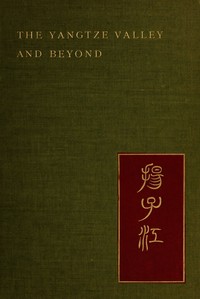
The Yangtze Valley and beyond : an account of journeys in China, chiefly in…
Forget everything you think you know about Victorian women travelers. The Yangtze Valley and Beyond is the journal of Isabella Bird, a woman who, at an age when most of her contemporaries were settling into quiet retirement, decided to embark on one of the most grueling journeys of her life. In 1896, she traveled over 8,000 miles through the heart of China.
The Story
The book follows her path from Shanghai, up the mighty Yangtze River on a steamer, and then—crucially—into the unmapped interior. She leaves the relative safety of the river to trek through Sichuan province, an area few Westerners had ever seen. She describes everything: the breathtaking landscapes of gorges and mountains, the bustling cities and remote villages, the intricate social customs, and the stark poverty. She travels by boat, by chair carried by porters, and on horseback, facing brutal weather, primitive accommodations, and constant curiosity (and sometimes hostility) from local populations. The narrative is driven by her daily struggles and observations, painting a vivid, street-level picture of China on the cusp of the Boxer Rebellion.
Why You Should Read It
What makes this book so compelling is Isabella Bird herself. She is a bundle of contradictions. She’s a product of her time, making comments that will make you cringe, but her curiosity always wins out. She genuinely tries to understand the people she meets, from mandarins to farmers. Her descriptions are incredibly detailed—you can almost smell the marketplaces and feel the mist of the river. You read it for that unvarnished, first-person perspective. It’s not a sanitized, diplomatic report; it’s the real, messy, exhausting, and wonderful experience of travel in an era before guidebooks and smartphones. She doesn’t romanticize the "Orient," but she finds profound beauty and humanity in it.
Final Verdict
This is a perfect read for anyone who loves real-life adventure stories, armchair travelers, and history fans who want to go beyond dates and treaties. If you enjoy writers like Bill Bryson or Paul Theroux, you’ll appreciate Bird’s sharp eye and personal voice, even if she’s from a different century. Be prepared for a challenging but rewarding journey. It’s not a fast read, but it’s a deeply immersive one. You’ll close the book feeling like you’ve traveled every dusty mile right alongside one of history’s most formidable explorers.
This content is free to share and distribute. Feel free to use it for personal or commercial purposes.
Joseph Martin
1 year agoA must-have for graduate-level students in this discipline.
Patricia Garcia
4 months agoAfter spending a few days with this digital edition, the insights into future trends are particularly thought-provoking. I'm glad I chose this over the other alternatives.
John Miller
8 months agoFrom a researcher's perspective, the language used is precise without being overly academic or confusing. It’s hard to find this much value in a single source these days.
Barbara Jones
4 months agoAfter a thorough walkthrough of the table of contents, the argument presented in the middle section is particularly compelling. Definitely a five-star contribution to the field.




Matthew Lee
10 months agoInitially, I was looking for a specific answer, but the attention to detail regarding the core terminology is flawless. This is a solid reference for both beginners and experts.