
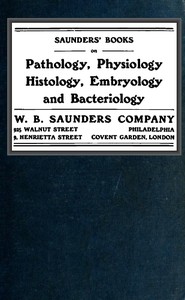
Saunders' Books on Pathology, Physiology Histology, Embryology and Bacteriology
So, my friend asks, 'Why are you reading a 120-year-old textbook for fun?' Fair point. But ‘Saunders’ Books on Pathology, Physiology, Histology, Embryology and Bacteriology’ is way more than a dusty manual. It’s a front-row seat to the greatest detective story ever told—the one where humanity figured out what germs are and how our bodies really work.
The Story
This isn't a book you read cover to cover. It's a stack of classic textbooks in one big volume. Think of it like a buffet: you get Pathology (why organs mess up), Physiology (how the body should run), Histology (a tiny camera for tissues), Embryology (how we start), and Bacteriology (the bad guys). The 'plot' here is the massive leap in understanding that happened right around the early 1900s. All these new discoveries—germ theory, cells, microscopic anatomy—were just being shared with the world for the first time. Every page is a mini-revelation.
Why You Should Read It
First off, the writing is surprisingly clear. These scientists loved explaining stuff—no robot voices here. You’ll laugh at how wrong they got a few things (they thought some diseases came from ‘bad air’), but you’ll mostly be blown away by how much they already nailed. There’s a feeling of discovery on every page, like you’re in a secret club of smart folks from the past. Plus, the illustrations are unreal—color plates of slides and diagrams that look like art. You don’t need a science degree to enjoy this; you just need a sense of wonder about how your own body works.
Final Verdict
>>Perfect for: history buffs, medical nerds, anyone who loves origin stories—especially how we learned to upgrade from ‘guess and pray’ to ‘microscope and knew.’ It’s also great for writers looking for unique inspiration. Bottom line? This book is a rare gem: a window into a time when every diagnosis felt like winning a treasure hunt. Give it a shot—you’ll never look at a cough the same way again. Strongly recommended.
This digital edition is based on a public domain text. You do not need permission to reproduce this work.


Jennifer Taylor
7 months agoBefore I started my latest project, I read this and it addresses the common misconceptions in a very professional manner. This is a solid reference for both beginners and experts.