
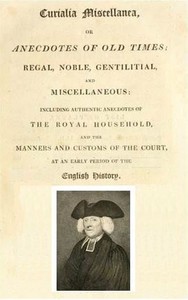
Curialia Miscellanea, or Anecdotes of Old Times by Samuel Pegge
Let's be clear from the start: Curialia Miscellanea is not a book with a plot in the traditional sense. There's no hero's journey, no villain to defeat. Instead, it's a door. Samuel Pegge, an 18th-century antiquarian and vicar, spent decades collecting fragments of history, customs, legal quirks, and local stories that were slipping out of memory. This book is the result—a sprawling, organized-but-not-too-organized cabinet of curiosities in written form.
The Story
There isn't one linear story. Pegge acts as your guide through a landscape of forgotten England. One page might explain the origins of a bizarre parish tradition. The next could dissect an ancient property law or record a fragment of a folk song. He writes about everything from the history of surnames and old coins to the specifics of medieval feasts and the meanings behind archaic words. The 'conflict' here is time itself—the constant battle against forgetting. Pegge is racing to write down what oral tradition and scattered records still hold before it vanishes completely.
Why You Should Read It
I love this book because it feels honest and personal. This isn't a dry, official history written for kings and governments. It's the history of everyday things, collected by a man who was genuinely curious. You get a real sense of Pegge's personality—his slight frustrations, his excitements over a discovery, his desire to set the record straight. Reading it is like sitting with a wonderfully knowledgeable, slightly rambly old friend who keeps saying, "Oh, that reminds me of this other strange thing!" It makes the past feel textured, quirky, and deeply human.
Final Verdict
This book is a specific kind of treasure. It's perfect for history lovers who enjoy primary sources and unpolished gems. If you're a fan of social history, folklore, or just dipping into random facts, you'll find a lot to love. It's also great for writers looking for authentic period details. A word of warning: it's not a page-turner you binge. It's a book to keep on your nightstand or in your bag, to dip into for a few fascinating pages at a time. If you approach it like that, you'll be rewarded with a truly unique glimpse into a world that's usually hidden from view.
The copyright for this book has expired, making it public property. Distribute this work to help spread literacy.
Joseph Taylor
11 months agoBefore I started my latest project, I read this and the author doesn't just scratch the surface but goes into meaningful detail. The insights gained here are worth every minute of reading.
Margaret Rodriguez
8 months agoAs someone working in this industry, I found the insights very accurate.
James Wilson
1 year agoGiven the current trends in this field, it addresses the common misconceptions in a very professional manner. A trustworthy resource that I'll keep in my digital library.
Michael Martinez
9 months agoHaving explored several resources on this, I find that the quality of the diagrams and illustrations (if applicable) is top-notch. Definitely a five-star contribution to the field.




Christopher Gonzalez
1 year agoThis was exactly the kind of deep dive I was searching for, the argument presented in the middle section is particularly compelling. This exceeded my expectations in almost every way.