
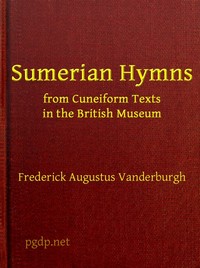
Sumerian Hymns from Cuneiform Texts in the British Museum by Vanderburgh
Okay, let's clear something up right away: this book doesn't have a plot in the traditional sense. There's no hero's journey or murder mystery. Instead, the 'story' is the collective voice of a civilization. Vanderburgh acts as our translator, presenting a series of hymns originally pressed into wet clay with a reed stylus. These are songs and prayers dedicated to the major figures of the Sumerian pantheon—gods like Enlil, the stern lord of the wind, and Inanna, the passionate goddess of love and war.
The Story
The book is organized like a sacred playlist. Each hymn is a snapshot. One might be a formal, rhythmic praise song from a temple priest, listing a god's titles and powers to gain favor. The next could be a simpler, more desperate plea from a community for a good flood of the Tigris River to water their crops, not a destructive one. You'll find love songs that feel surprisingly tender and epic tales of divine drama. Reading them, you piece together a world where the divine was in everything—the rising sun, the annual flood, the success of a date harvest. The 'conflict' is the human struggle to live well in that world, to appease unpredictable gods, and to find beauty and order through ritual and poetry.
Why You Should Read It
I picked this up out of curiosity and was stunned by its emotional weight. The hymns break down the wall of 'ancient history.' These aren't dry political records; they're raw, human documents. When a hymn begs the god of storms for gentle rain, you feel the farmer's anxiety. When a song exalts Inanna's beauty and power, you get a sense of awe that rivals any modern religious text. It makes the Sumerians real, not just a chapter in a textbook. My favorite parts were the smaller, more personal details—the description of a temple's fragrance, the specific breed of cattle offered to a god. It grounds the spiritual in the everyday.
Final Verdict
This is a niche book, but a profoundly rewarding one. It's perfect for history buffs who are tired of kings and battles and want to hear the people's voice. It's for poets and writers looking for the deepest roots of human creativity. It's also for anyone with a spiritual curiosity, interested in how humans first conceptualized the divine. It's not a beach read—you'll want to take it slow, maybe just a hymn or two at a time—but each page offers a breathtaking glimpse into the dawn of recorded thought. Keep your phone handy to look up the gods' names; it's worth the extra effort to build the cast of characters in your mind.
The copyright for this book has expired, making it public property. Enjoy reading and sharing without restrictions.
William Martinez
8 months agoHaving followed this topic for years, I can say that the author clearly has a deep mastery of the subject matter. Truly a masterpiece of digital educational material.
Mary Wilson
1 month agoA sophisticated analysis that fills a gap in the literature.
Christopher Gonzalez
9 months agoI particularly value the technical accuracy maintained throughout.
Donald Young
9 months agoAs someone who reads a lot, the arguments are well-supported by credible references. This story will stay with me.







William Harris
4 months agoFrom a researcher's perspective, the way it handles controversial points with balance is quite professional. This should be on the reading list of every serious professional.